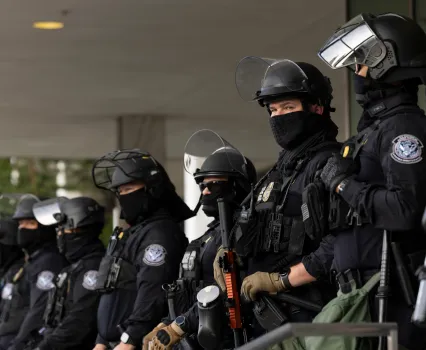
| With the federal government mired in a partial shutdown, the questions of whether ICE officers should be prohibited from wearing masks and required to display identification on their uniforms are occupying a great deal of attention in Congress and at the White House. But questions about ICE masking and ID practices are also bubbling along in the federal courts, thanks largely to laws in some states, such as California, that seek to regulate ICE personnel in these ways. And recently a federal district court issued an important, albeit preliminary, decision in a lawsuit filed against California by the federal government, involving precisely these issues. The decision, by federal district judge Christina Snyder, illustrates fundamental confusion on the part of at least some judges, law clerks, and analysts. | | At issue in the February 9 ruling in United States v. California was whether the federal government should be entitled to block, at least for now, two California enactments, SB 627 (the so-called “No Secret Police Act”) and SB 805 (the so-called “No Vigilantes Act”). In broad-brush terms, SB 627 prohibits, under pain of misdemeanor penalty, almost all law enforcement officers operating in the state—whether the officers be federal, county or local—from covering their faces (i.e., wearing masks) when engaging with members of the public. The measure contains various exemptions—e.g., for police officers engaged in Special Weapons and Tactics (SWAT) operations, and officers working undercover or pursuant to the directives of a court order. SB 805, a parallel enactment, requires each law enforcement officer operating in California to, while performing his enforcement duties, visibly display on his uniform identification that includes his agency and either his name or badge number. | | The United States challenged both provisions as running afoul of the Supremacy Clause in Article VI of the U.S. Constitution. Under this provision, the Supreme Court has made clear (for instance, as recently as 2022 in United States v. Washington), that state laws “that either regulat[e] the United States directly or discriminat[e] against the Federal Government or those with whom it deals (e.g., contractors)” are prohibited, unless the federal government assents (emphasis in original and internal quotations and citations omitted). | | Purporting to apply this framework, Judge Snyder preliminarily blocked SB 627 because, she concluded, the statute’s failure to explicitly mention and cover state-level law enforcement officers effectively made it discriminatory with respect to the federal government. But she declined to block 805 because it applied to all law enforcement officers (federal, state, and local) evenhandedly, and was not a “direct” regulation of the federal government insofar as it did not threaten to “transform,” “prevent,” or “destroy” federal law enforcement operations. | | Putting aside whether Judge Snyder correctly viewed SB 627 as discriminatory (a complex question for the same reason that all discrimination questions can vexingly depend on what we count as the baseline), the grievous error in Judge Snyder’s reasoning is that she fundamentally misunderstands what it means for a state to “directly” regulate the federal government. | | Both SB 627 and SB 805 directly regulate the federal government because these laws explicitly tell federal employees what they can and cannot do while on the job. Period. And once a state directly regulates federal entities or employees, the only thing that can save the state law is federal assent to the application of state regulation. (For that reason, even if SB 627 were amended to apply explicitly to state officers alongside federal and local officers, the measure would be unconstitutional.) | | For starters, note that the Supreme Court itself, in its recent treatment of this subject, has italicized the “either” and the “or” in describing the two categories of displaced state laws. This italicization highlights that direct regulation and discriminatory regulation are two separate categories of forbidden (absent federal assent) state laws. If a state law applies directly against the federal government yet doesn’t discriminate against the federal government, it is nonetheless invalid—unless there is a clear reason to believe that the federal government desires its officials to be subject to state law. | | But what, exactly, constitutes direct, vs. indirect, regulation? As I explain in depth in forthcoming academic scholarship, broadly speaking, indirect regulations are state laws that regulate individuals, including those who happen to work for the federal government, in their private or personal capacities (albeit in ways that might increase costs to the federal government), rather than qua federal employees on the job. For example, a law requiring everyone in a state to pass an onerous test to obtain a driver’s license in order to operate a private motor vehicle on the roadways might indirectly impair federal efficiency to the extent that federal-employee recruitment may be hampered because some would-be federal employees or contractors might prefer to live in states that lack such onerous requirements. But a law that tells a mail carrier how he must (or cannot) discharge his job, e.g., the directive that he has to have a driver’s license when performing the federal job of delivering the mail, is a direct regulation of federal operations, and is thus invalid (as the Supreme Court in fact held) unless Congress has chosen to subject mail carriers to state law (which it likely would for speeding and red-light laws). And that is true without the federal government having to show that the state-law licensing requirement significantly affects mail-delivery efficiency. | | In cases of indirect effect (which fall under the rubric of “conflict preemption”), where states are regulating private parties in ways that might impede congressional goals, the Supreme Court has, in the absence of express congressional preemption, explored the extent to which important federal objectives are actually impaired before it has invalidated state laws (in the same way that Judge Snyder purported to examine, on her own, how much ID requirements actually impair ICE operations.) | | But where regulation is direct—that is, where states are regulating the federal government itself (and that includes its employees), telling the federal government how to discharge its powers rather than regulating private persons in ways that might conflict with federal engagement of those same private persons—the presumption against preemption and the need for demonstration of an actual frustration of federal objectives do not apply; instead the (only) question is whether Congress has chosen to subject federal employees to state regulation. | | Judge Snyder’s opinion fails to appreciate these important distinctions. In her opinion, she discusses the need for a “functional” analysis to resolve the federal-state conflict raised by SB 627 and SB 805, and she takes the view that state law should survive unless the federal government can demonstrate grave consequences in having to follow it. | | But, and this is key, all of the cases Judge Snyder’s opinion cites and quotes to support her “functional” analysis involve state laws that regulate private actors who interact with the federal government, rather than federal employees on the job themselves. This includes Ninth Circuit and Sixth Circuit cases involving state laws regulating private detention centers that contract with the federal government. And it includes Supreme Court caselaw involving state laws that regulate alcohol distributors who supply federal facilities. Judge Snyder does not cite, as supporting her position, a single case (certainly not from the Supreme Court nor, as far as I can tell, from a Court of Appeals) that involves state regulation telling federal employees themselves how they must discharge their jobs. | | Such cases would be exceedingly hard, if not impossible, to find, because the Supreme Court has time and again declared that states cannot, absent federal assent, regulate how federal employees perform their federal duties. In the seminal case of Johnson v. Maryland, the Court crisply differentiated between cases “deal[ing] with the conduct of private persons in matters in which the States as well as the general government have an interest,” and those in which a state has attempted to “interrupt the acts of the general government itself.” | | Representative quotes from the Supreme Court in subsequent cases include the following: | We may assume . . . that, in the absence of congressional consent, there is an implied constitutional immunity of the national government from . . . state regulation of the performance, by federal officers and agencies, of governmental functions.
The activities of the Federal Government are free from regulation by any state.
The law has long been settled that . . . regulation cannot be imposed on federal instrumentalities by the States, under the Supremacy Clause, unless the Federal Government directly indicates that it finds such impositions to be consistent with the proper pursuit of its powers under federal law.
| | Indeed, some of the cases cited by Judge Snyder for the proposition that a “functional” analysis applies and that the actual harm to federal interests must be documented themselves explicitly made clear such an analysis does not apply where a state explicitly regulates federal employees’ job duties. For example, Judge Snyder quoted (out of context) language from an opinion in North Dakota v. United States, which involved a state law that regulated private liquor distributors. Yet in that ruling, the Court made clear that “direct” regulation are laws that operate on the federal government: “There is no claim in this case, nor could there be, that North Dakota regulates the Federal Government directly [because the law] operate[s] against [private] suppliers, not the Government.” | | Some of the cases from U.S. Courts of Appeals similarly make clear they do not implicate direct regulation of the federal government because the state laws in question regulate private actors who contract with the federal government rather than the federal government itself. And yet Judge Snyder’s opinion draws heavily from these inapposite rulings as well. | | The short of it is that, where a state regulates federal entities or personnel qua federal actors, the state law is unconstitutional absent demonstration of affirmative federal assent. (And no one argues that such assent exists with regard to ICE masking and identification policies. Given that federal law does regulate masking and identification policies in other, specified, settings, and given that no one on Capitol Hill today is suggesting that current ICE masking and identification practices violate federal statutes or constitutional, such an argument would seem an uphill battle.) | | The perils of any other approach are quite clear when we examine how Judge Snyder performs the “functional” analysis. Consider the following passage from her opinion: | [The United States] argue[s] that discretionary policies for masking and identification are critical to officer safety because the exposure of federal agents’ identities exposes those agents to greater risks of being doxxed, harassed, assaulted or threatened. . . . The United States argues that these increased risks, in turn, increase security costs the federal government incurs to protect its officers. . . . The Court does not discount these real harms that impact federal officers. However, these harms are the result of criminal behavior. A rule that prohibits law enforcement officers from wearing masks or requires them to have visible identification does not facilitate or enable criminals to harm law enforcement officers.
| | While the reasoning of this passage is very far from clear, the apparent suggestion is that because the harms that might befall federal officers (and thus the federal government) would arise from private, criminal conduct, the state isn’t in any meaningful way causing the harms (and resulting impairment of federal enforcement) to occur. To paraphrase the passage is to demonstrate its implausibility. | | More generally, the difficulty with a “functional” analysis is precisely that it leaves to judges ad hoc balancing of incommensurable costs and benefits. That is why, in the famous McCulloch v. Maryland case involving Maryland’s effort to tax the Bank of the United States, Chief Justice John Marshall’s unanimous opinion for the Court eschewed any kind of balancing test. Chief Justice Marshall reasoned that the power to tax (or regulate, as he also observed) involves the power to destroy. If a state can tax (or regulate) one federal entity, it can tax (or regulate) multiple federal agencies. And if it can tax (or regulate) a bit, it can tax (or regulate) a lot. These slippery slope problems explain why, in the context of direct state taxation or regulation of federal operations, the Court has embraced a bright-line rule that invalidates the state law in question unless there is clear federal assent. Perhaps the costs of the kind of “functional” test Judge Snyder embraces are worth paying in order to respect federalism and the presumption against federal preemption that obtains when states regulate citizens without regard to federal activities, but as Seth Waxman and Trevor Morrison have put the point: “[I]f direct state regulation of federal actors at all [without regard to degree] interferes with federal law or policy, courts will hold it preempted” . . . [because] “the presumption against preemption has little, if any, role to play in cases involving state attempts to regulate the federal government or its agents directly.” | | Judge Snyder’s ruling is set to go into effect today, February 19. Whether the United States seeks to block it before or after it goes into effect, my prediction is that ultimately a higher court will correct the analytic errors of the ruling. |
|


 Have friends who like law? Forward this email.
  Like Verdict for legal discussions on Facebook.
  Follow @verdictjustia for news and updates on Twitter.


