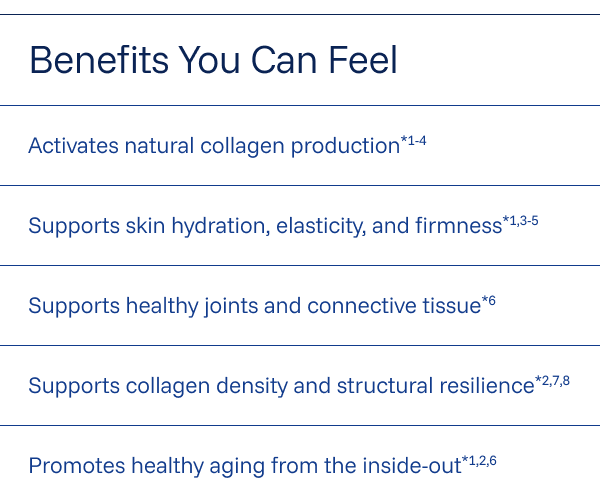
Don’t just add collagen — Pro Collagen Activator works by triggering your body’s own collagen production system.*
|
|
Don’t just add collagen — Pro Collagen Activator works by triggering your body’s own collagen production system.*
| |
Collagen is your body's most abundant structural protein — found in skin, bones, joints, ligaments, and connective tissue. But collagen production starts to drop as early as your 20s, by about 1-1.5% each year. *1
By your 40s, that steady decline becomes visible and physical: skin loses firmness, joints feel weaker, and connective tissues become less resilient.*1,9-11
|
|
Collagen is your body's most abundant structural protein — found in skin, bones, joints, ligaments, and connective tissue. But collagen production starts to drop as early as your 20s, by about 1-1.5% each year. *1
By your 40s, that steady decline becomes visible and physical: skin loses firmness, joints feel weaker, and connective tissues become less resilient.*1,9-11
| |
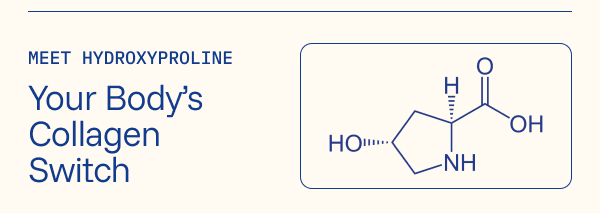
Hydroxyproline is a rare amino acid found only in collagen.
It plays a critical role in giving collagen its unique triple-helix shape — the very structure that allows collagen to be strong, stable, and resilient.*7,8
But hydroxyproline is more than a building block — it’s a signal.*2,4,12-14
When collagen breaks down (from age or activity), hydroxyproline enters the bloodstream, triggering your body to ramp up collagen production. Supplementing with hydroxyproline gives your body both the raw material and the signal to renew collagen as you age.*1-4
|
|
Hydroxyproline is a rare amino acid found only in collagen.
It plays a critical role in giving collagen its unique triple-helix shape — the very structure that allows collagen to be strong, stable, and resilient.*7,8
But hydroxyproline is more than a building block — it’s a signal.*2,4,12-14
When collagen breaks down (from age or activity), hydroxyproline enters the bloodstream, triggering your body to ramp up collagen production. Supplementing with hydroxyproline gives your body both the raw material and the signal to renew collagen as you age.*1-4
| |
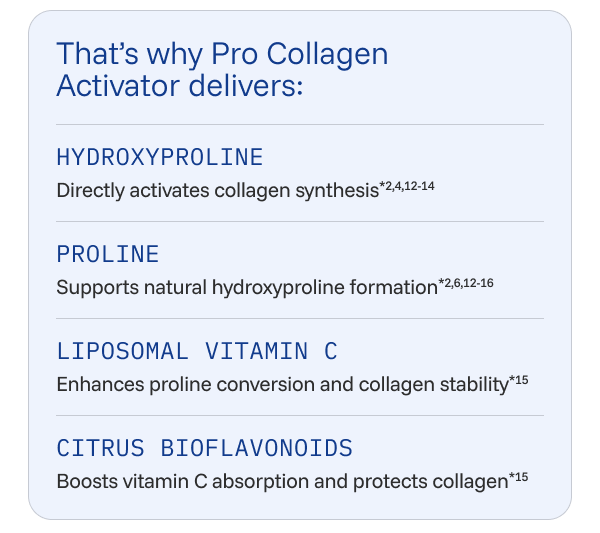
Hydroxyproline is critical — but it's not the whole story. Your body can make its own hydroxyproline from proline, a process powered by vitamin C.
|
|
Hydroxyproline is critical — but it's not the whole story. Your body can make its own hydroxyproline from proline, a process powered by vitamin C.
| |
This systems-level approach helps fuel collagen production from multiple angles — so your body can build and sustain strong, healthy tissues.*2,4,6,12-16
|
|
This systems-level approach helps fuel collagen production from multiple angles — so your body can build and sustain strong, healthy tissues.*2,4,6,12-16
| | References: - Liu H et al. Photodermatol Photoimmunol Photomed. 2024;40(1):e12931.
- Li P and Wu G. Amino Acids. 2018;50(1):29-38.
- Chen L et al. Food Funct. 2023;14(23):10628-10638.
- Ohara H et al. J Dermatol. 2010;37(4):330-338.
- Barati M et al. J Cosmet Dermatol. 2020;19(11):2820-2829.
- Haas E. In: Staying Healthy with Nutrition. 2006.
- Martínez-Puig D et al. Nutrients. 2023;15(6):1332.
- López-Martínez MI et al. Front Nutr. 2022;9:926043.
- Tobin DJ. J Tissue Viability. 2017;26(1):37-46.
- Oikarinen A. Photodermatol Photoimmunol Photomed. 1990;7:3-4.
- Ganceviciene R et al. Dermatoendocrinol. 2012;4(3):308-319.
- Wu G et al. Amino Acids. 2011;40(4):1053-1063.
- Shigemura Y et al. J Agric Food Chem. 2009;57(2):444-449.
- Asai TT et al. Int J Mol Sci. 2019;21(1):229.
- Khatri M et al. Amino Acids. 2021;53(10):1493-1506.
- Karna E et al. Cell Mol Life Sci. 2020;77(10):1911-1918.
| | | | |