Your login is via your account |
|
|
⚠️ Default Distress: What Private Credit Troubles Could Mean for Regional Banks The high-profile failures of First Brands and Tricolor have left investors fearing that troubles in private credit could extend to regional banks and the broader stock market. First Brands, a car parts company, filed for bankruptcy in late September as creditors became concerned about the company's liabilities, which far exceeded its assets. Tricolor, a car dealership and subprime auto lender, filed for Chapter 7 liquidation weeks earlier after allegations that it had pledged the same collateral on multiple loans. Both companies relied on private credit lenders who are now suffering losses. As a result, many fear that those losses could cascade throughout the entire private credit market. Compounding these fears, Western Alliance and Zions Bank have discovered allegedly fraudulent activity by borrowers. It's no surprise that the KBW Regional Bank Index (KRX) has fallen more than 6% in the last month. In this week’s piece, we’ll: - Explain what’s happening in the world of private credit
- Review why the industry presents new risks today
- Identify how investors can reduce downside exposure
🎧 Would you prefer to listen to these insights? You can find the audio version on our Spotify, Apple Podcasts or our YouTube! (Released by 5pm Monday AEST). |
|
|
Quote of the week
"Banks get in trouble for one reason: They make bad loans." Carl Webb |
|
|
What Happened In The Markets This Week? Here’s a quick summary of what’s been going on: 🧑⚖️ Supreme Court justices appear skeptical that Trump tariffs are legal (CNBC) - The Supreme Court looks likely to strike down Trump’s sweeping tariffs, with justices across the spectrum skeptical that the president can unilaterally impose taxes under the IEEPA (International Emergency Economic Powers Act).
- If overturned, the government might owe $750 billion in refunds to importers, which could trigger a fiscal jolt and disrupt Treasury plans for 2026.
- A rollback would also upend trade assumptions for companies relying on current tariff protections.
- Tariff-heavy importers like retailers, toy companies, and wine distributors could see relief, but any retroactive refunds would be messy and litigation-prone.
- Markets might cheer a decision seen as inflation-friendly, but uncertainty over timing and scope keeps pricing cloudy for now.
- A SCOTUS ruling against Trump’s tariffs could unwind $3 trillion in projected revenue by 2035, and shake trade-dependent sectors, so watch for volatility in tariff-sensitive names.
🇺🇸 U.S. markets stabilize after tech rout (WSJ) - Markets bounced back modestly after a tech-driven dip, but lingering doubts about AI valuations and Trump’s tariff policy kept nerves frayed.
- It seems investors are eyeing the Supreme Court case mentioned above as a potential catalyst to reprice risk in trade-dependent sectors and shift inflation expectations.
- AI remains the main engine for the 2025 rally, but rising capital spending from firms like Meta is forcing a reality check. Companies that miss expectations (like Palantir) may get punished harder.
- Bond yields and gold held steady, suggesting markets are hedging against both rate and geopolitical risks while equity volatility cooled slightly.
- While the AI trade is still on, some argue cracks are forming. As we always mention, use our portfolio tool to make sure your exposure matches your risk tolerance and objectives.
To see our take on these market stories below, simply check out the full article! -
🚗 Toyota raises forecast despite an expected hit from U.S. tariffs (CNBC) 📲 Meta still wants to have its iPhone moment (Sherwood) 🤝 OpenAI, Amazon sign $38 billion cloud deal (WSJ) 🛢️ Oil holds two-day drop after US stockpiles rise most since July (Bloomberg) Now let’s dive into the main piece! |
🧠 Why the Topic of Private Credit is So Public
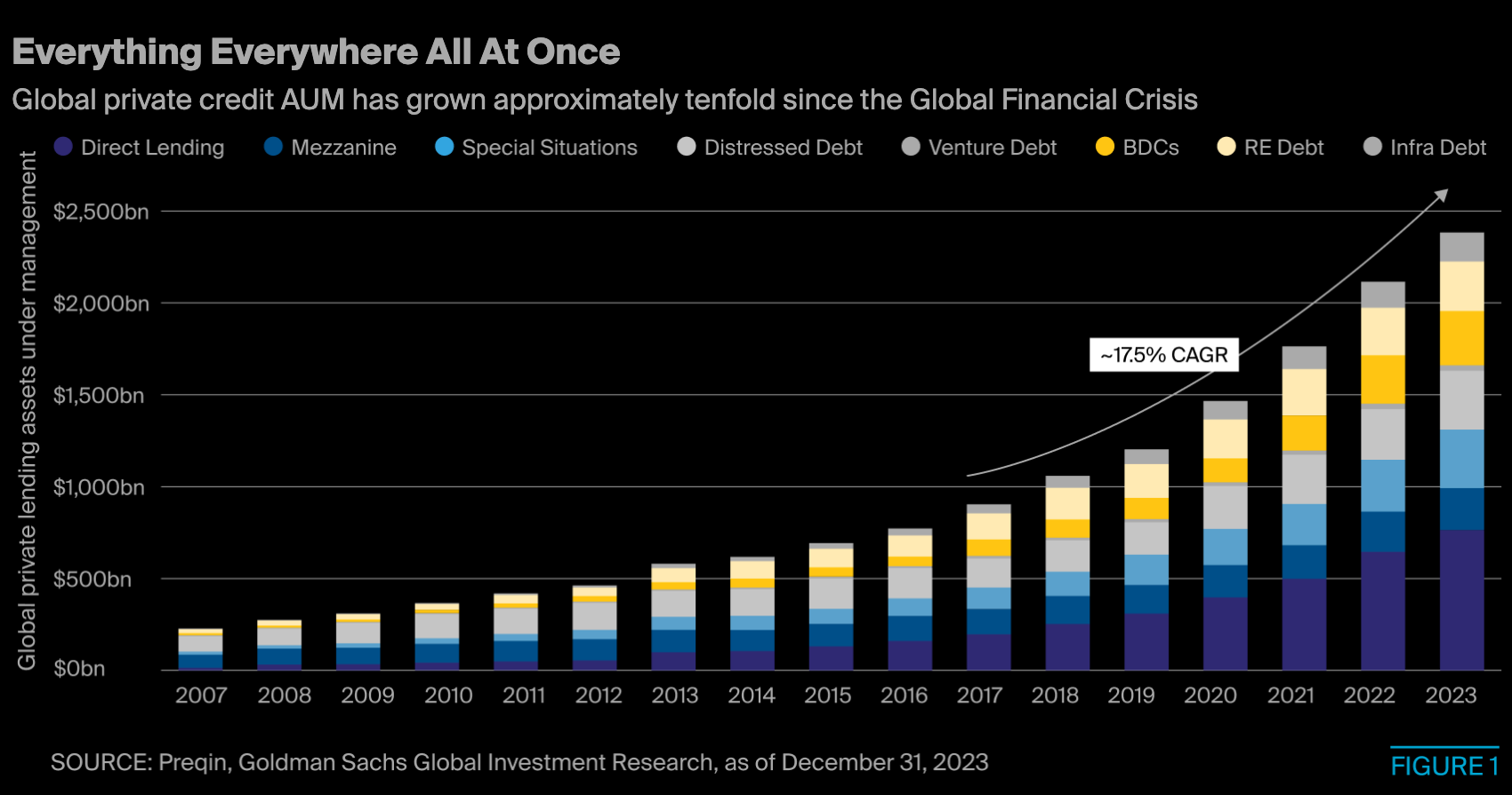
Private credit is nothing new. The idea is simple: private investors, such as insurers, pension funds, and high-net-worth individuals, offer loans to businesses. This approach differs from traditional lending, in which banks issue loans partially backed by customer deposits. So if private credit has been chugging along for four decades, why is everyone talking about it now? There are three reasons: 💰1. Private Credit is Booming After the Global Financial Crisis (GFC) of 2008, the game of banking changed. Regulators stepped in and required large bank holding companies to adhere to stricter standards, including higher capital and liquidity requirements. Regulators also required banks to perform more thorough reviews of borrowers. Essentially, lending became more complex and expensive. This was where private credit stepped in. As borrowers encountered increasingly restrictive banks, they turned to private creditors, classified as non-bank financial institutions (NBFIs), also known as the shadow banking sector. They can act more freely than traditional banks. They also benefited from the low interest rates of the post-GFC, which allowed them to access cash inexpensively. |
Alternative asset managers like KKR, Blackstone, Ares, and Apollo have helped private credit grow from about $500 billion in assets under management (AUM) to $3 trillion today. |
Private credit’s stellar returns pulled in capital but recent failures reveal cracks investors must watch. We unpack what strong performance has masked and how to manage the risks. So our full piece covers: 📈 Why returns drew record inflows and where exposure is concentrated. 🧨 Where risks are surfacing across NDFIs, recent bankruptcies, and bank linkages. 🛡️ Practical ways to limit downside from mapping NDFI lenders to right-sizing financials. 🔎 A targeted screen for quality financials including the latest adds you can review now. |
|
|
💬 Join the discussion by leaving a comment!
Where’s your safety valve: quality banks, diversified financials, cash or something else? |
|
|
Key Events During the Next Week Tuesday - 🇦🇺 Westpac Consumer Confidence
- ⬆️Forecast: 2.8 Previous: -3.5%
- ▶️ Why it matters: Better sentiment supports household spending and soft-landing hopes.
- 🇬🇧 Unemployment rate
- ⬆️Forecast: 4.8% Previous: 4.7%
- ▶️ Why it matters: A softer labour market keeps BoE rate cuts in play.
Thursday - 🇬🇧 GDP Growth Rate YoY Preliminary
- ⬇️ Forecast: 1.3% Previous: 1.4%
- ▶️ Why it matters: Slower growth pressures the BoE to stay dovish.
Friday - 🇨🇳 Industrial Production
- ⬇️ Forecast: 5.8% Previous: 6.5%
- ▶️ Why it matters: Weaker factory output signals softer global demand and can weigh on commodities.
- 🇨🇳 Retail Sales YoY
- ⬇️ Forecast: 2.2% Previous: 3%
- ▶️ Why it matters: Slower consumer spending makes China’s recovery look uneven.
Earnings season is in full swing, and here are more big names reporting this coming week: |
Until next week, invest well. Simply Wall St |
|
|
| | This email is from Simply Wall Street Pty Ltd
Level 5, 3 20 Pitt St Sydney 20 00, NSW, Australia. | | Simply Wall St has no position in the company(s) mentioned. Simply Wall Street Pty Ltd (ACN 600 056 611), is a Corporate Authorised Representative (Authorised Representative Number: 467183) of Sanlam Private Wealth Pty Ltd (AFSL No. 337927). Any advice contained in this email/website is general advice only and has been prepared without considering your objectives, financial situation or needs. You should not rely on any advice and/or information contained in this website and before making any investment decision we recommend that you consider whether it is appropriate for your situation and seek appropriate financial, taxation and legal advice. Please read our Financial Services Guide before deciding whether to obtain financial services from us. | | | Don’t want to receive Market Insights? Unsubscribe
Want to stop receiving emails or check which emails you are subscribed on? Manage email preferences | | |
|
|
|
|