Your login is via your account |
|
|
🚦 The Winners and Losers From The Stablecoin GENIUS Act The Senate just passed the “GENIUS Act” to finally regulate these crypto-dollar tokens (yep, that’s really the name, we’ll explain what it stands for). When you hear “stablecoins,” just think digital dollars on a blockchain. Whether you’re a crypto newbie or a battle-hardened market veteran, it’s worth knowing about the consequences of this development. If it gets through the Republican-led House and to the President’s desk, it will get signed into federal law. So this week, we’re unpacking: - What stablecoins are,
- Why Washington cares so much about them, and
- Who the big winners and losers might be.
Most importantly, we’ll connect the dots to investment decisions, from the stocks that could benefit to the risks you should watch. |
|
|
This week's Market Insights is a 7.5 minute read! (or read the full article) 🎧 Would you prefer to listen to these insights? You can find the audio version on our Spotify, Apple Podcasts or our YouTube! (Released by Monday 5pm AEST). |
Quote of the week "A thriving stablecoin ecosystem will drive demand from the private sector for US Treasuries, which back stablecoins. This newfound demand could lower government borrowing costs and help rein in the national debt. It could also onramp millions of new users across the globe to the dollar-based digital asset economy." Treasury Secretary Scott Bessent |
|
|
What Happened In The Markets This Week? Here’s a quick summary of what’s been going on: 🚀 Bezos and Blue Origin Try to Capitalize on Trump-Musk Split (WSJ) - The Trump-Musk split has cracked open a rare opportunity for Jeff Bezos to pitch Blue Origin as the new go-to space partner.
- With SpaceX dominating NASA and military contracts, Blue Origin is angling for a bigger slice, backed by cozy chats with Trump and a PR blitz featuring weddings and White House visits.
- If Bezos can flip Trump’s favor, expect future contracts to shift, especially lunar and Mars-linked projects. But Blue Origin must first prove it can match SpaceX’s launch tempo and reliability.
- A political pivot could give Blue Origin lift-off, but performance will decide who gets the next billion-dollar launch, not charm.
🏦 Federal Reserve Releases Plan to Relax Key Bank Capital Rule (Bloomberg) - The Fed is proposing to ease capital requirements for big banks, trimming the enhanced supplementary leverage ratio from 5-6% down to 3.5-4.5%.
- The move could free up over $200 billion at bank subsidiaries, potentially boosting their Treasury market activity, though the Fed says it won’t let that capital flow straight to shareholders.
- This could support liquidity in Treasuries and help stabilize bond markets during stress. But critics warn it heightens systemic risk and weakens banks' loss buffers.
- Loosening capital rules may help banks buy more Treasuries and keep bond markets running smoothly, but it also means they’ll have less of a cushion if things go wrong. So there’s a trade-off between stability and flexibility.
🇺🇸 U.S. plans crackdown on allied chip plants in China (WSJ) - The U.S. is weighing up the removal of waivers that let Samsung, SK Hynix, and TSMC ship U.S. chip tools to their China plants without case-by-case licenses.
- If revoked, this could disrupt global chip supply chains and complicate U.S. trade and defense relationships with key allies like South Korea and Taiwan.
- Investors in chipmakers should watch for supply bottlenecks, higher costs, or plant slowdowns.
- If the U.S. tightens chip rules, expect global supply chain turbulence, especially for memory and logic chips, and a scramble by allies to protect their China operations.
To see our take on these and other market stories, simply check out the full article! 💸 SoftBank's Son pitches $1T Arizona AI hub (Bloomberg) ☁️ Nvidia threatens tech giant profits with move into cloud computing (WSJ) 👟 Nike says tariffs will cost it $1 billion before price increases, supply chain shifts (CNBC) Now let’s dive into the main piece! |
🤔 Stablecoins 101: Digital Dollars Stablecoins are simply a crypto token that is pegged 1:1 to a fiat currency (most are to USD). In plain English, 1 USD-backed stablecoin should always be worth $1 USD. To keep that stable value, reputable issuers hold real assets in reserve for every token issued. Typically, this means cash or ultra-safe investments like U.S. Treasury bills. For example, Tether and Circle – issuers of the two biggest stablecoins (USDT and USDC) – together hold about $166 billion in U.S. Treasuries to back their respective tokens. If you own a stablecoin, you’re essentially holding a digital IOU for a dollar, which you can usually redeem or cash out with the issuer. |
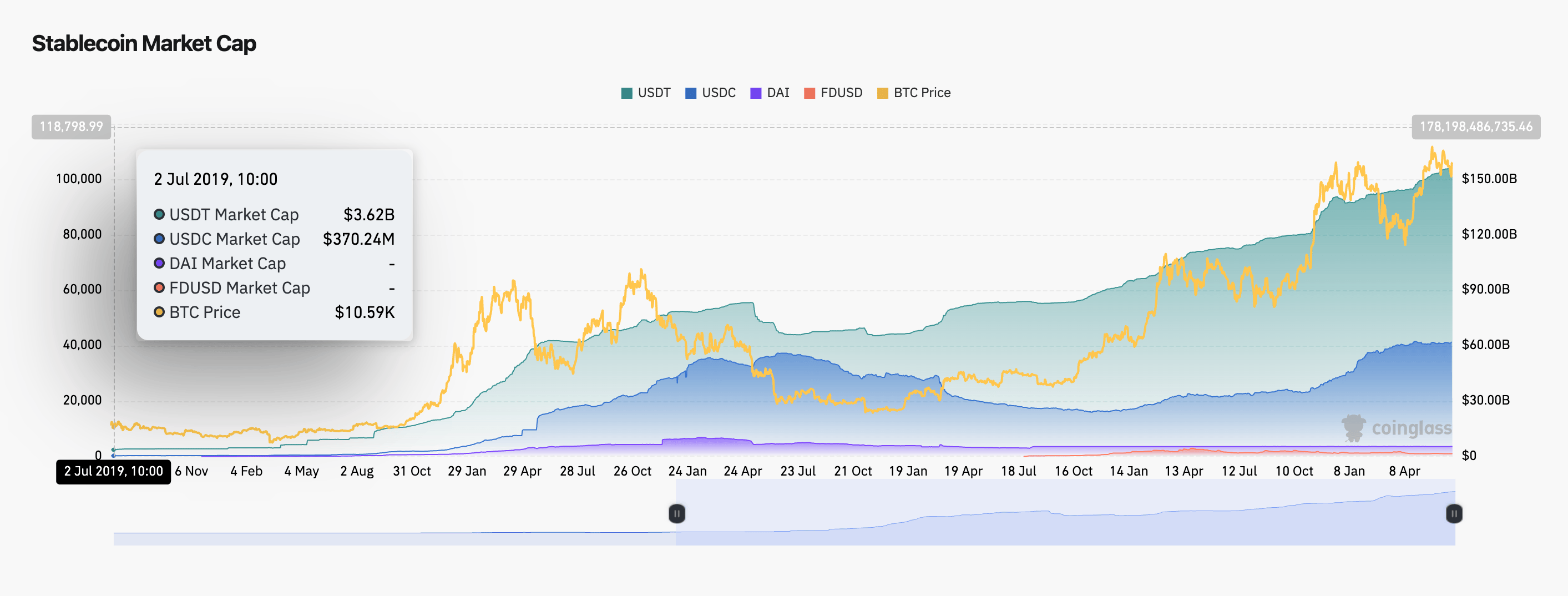
Stablecoins market Cap - Coinglass
(Green: Tether’s USDT. Blue: Circle’s USDC, Yellow: Bitcoin price) |
People use stablecoins because they combine the stability of the US dollar with the speed and reach of crypto. More and more, businesses and individuals are using stablecoins for cross-border payments and remittances. You can send money overseas in minutes, 24/7, often for pennies in fees, bypassing the slow, costly bank wires. In countries with unstable currencies, people even use USD stablecoins to store savings and protect against inflation. Yes, the USD also faces inflation, but compared to currencies like the Turkish lira, Argentine peso, and many others, it’s still the most stable of the bunch.
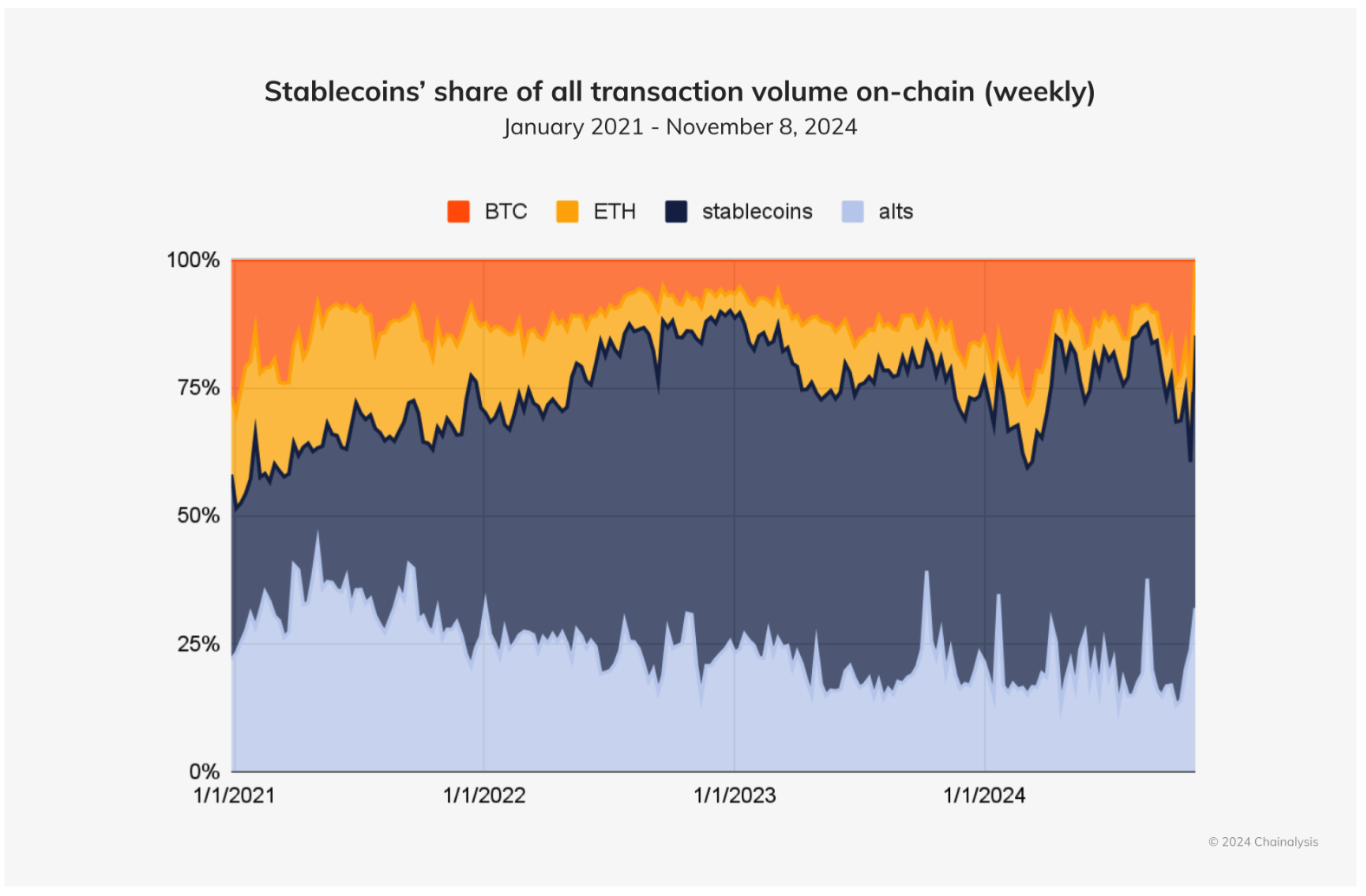
Stablecoins are becoming the digital cash of the internet economy. Their rise has pumped liquidity into crypto (they account for over two-thirds of crypto transaction volume) while also creeping into mainstream finance. |
According to Deutsche Bank, stablecoin transactions hit $28 trillion last year, which is more than Mastercard and Visa networks combined. Some major U.S. Banks, Amazon, and Walmart are all discussing issuing their own stablecoin, while the likes of PayPal have already done so with PYUSD. Understanding stablecoins’ use cases gives us a better idea of why they’re growing in popularity. With this much interest, this niche is poised to get much bigger, and that’s where the GENIUS Act comes in. |
🏛️ The GENIUS Act: A New Sheriff in Stablecoin Town The catchy name stands for the Guiding and Establishing National Innovation for U.S. Stablecoins Act of 2025, (Congress loves their acronyms). This landmark legislation is the first comprehensive U.S. framework for stablecoins. In a nutshell, it’s about bringing stablecoins out of the regulatory gray zone and into a supervised, legitimate market. Legal firm Arnold & Porter did a comprehensive breakdown of the bill, but here’s what it does (and doesn’t do): - 🔐 Who can issue
- Only regulated, approved entities can issue payment stablecoins now.
- 💱 Fully backed reserves
- 🔎 Transparency
- Issuers must publish monthly reserve reports detailing what’s backing the coins, and get those reports audited by an independent accountant.
- 🚫 What’s not allowed
- The Act pointedly forbids stablecoin issuers from paying interest or yield on the coins.
- ⚖️ Federal & state oversight
- The GENIUS Act sets up a federal oversight regime (with the Fed, OCC, FDIC, etc., divvying up supervision) but also lets states keep regulating smaller issuers.
- 🛡️ Enforcement teeth
- Issuing a stablecoin in the U.S. without approval becomes illegal.
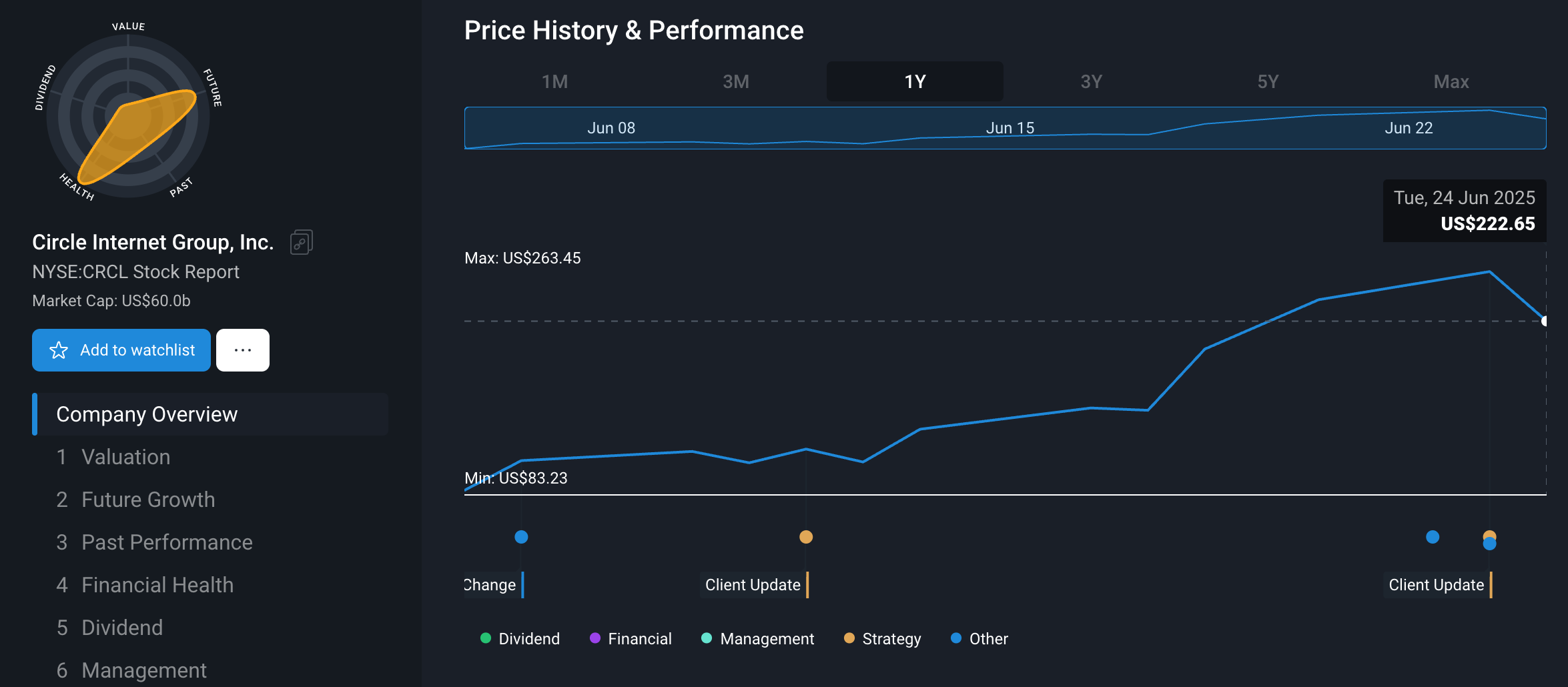
(Our full article goes into all the nuance of each point made above, so check it out if you want to go deep on the nuance of the bill.) ✨ For the first time, the U.S. is officially recognizing and codifying stablecoins as a part of the financial system. This clarity is expected to spur growth because legitimate players now have a rulebook to follow. Imagine previously interested institutions (big fintechs, banks, corporations) saying, “We’d use stablecoins if we knew we weren’t breaking laws.” Now they have the green light, which could trigger a wave of adoption. Regulatory risk premium goes down, investment and usage go up. What’s important here is that clarity reduces uncertainty. Companies like Circle (which just IPO’d) saw their stock jump on the Senate bill’s passage. And that was even after a stellar run from a $31 IPO price on June 5th to $143 by the 17th of June. |
Price History and Performance for Circle Internet Group - Simply Wall St |
In practical terms, we’ll likely see more traditional firms announcing stablecoin projects (as Fiserv did, inking a deal with PayPal and Circle right after the bill passed). The competitive landscape might shift quickly, and that brings opportunities and risks, depending on who adapts. But why pass stablecoin legislation now? |
|
|
🏦 The Goal: Boost Demand for the Dollar, Protect Banks Well, beyond consumer protection, lawmakers had two big goals with this legislation: - 💵 Strengthen the U.S. dollar and Treasury market
- 🏦 Shield banks from disruption
The Act is trying to engineer a win-win: grow the pie (of dollar usage) without knocking over the table (of financial stability). Let’s start with the first point. By creating a regulatory framework for USD-backed stablecoins, the U.S. is making it easier to export digital dollars globally, reinforcing the dollar’s reserve status. Since reserves must be held in Treasuries or cash, stablecoin growth naturally boosts Treasury demand. ✨ That demand could help lower borrowing costs and reduce reliance on foreign or Fed buyers. It’s a rare case where crypto growth serves government financing. Now, as for protecting banks, that’s probably anchored more around protectionism and stability, rather than innovation. Stablecoins may drain bank deposits, reducing cheap funding for them and pressuring banks to raise rates or lend less. To limit this, the GENIUS Act bans interest on stablecoin balances. No yield means less incentive to fully exit the banking system. Meanwhile, banks can still issue their own tokenized deposits (like JPM Coin) outside the Act’s rules, allowing them to compete without being handcuffed by legislation. It seems banks got their money’s worth with their lobbyists on the hill. ✨ The message is clear: regulators want innovation and dollar demand, but not at the expense of bank stability. As you can imagine, this benefits some and hurts others. |
To see the full breakdown of who’s smiling and who’s sweating in the stablecoin era, check out the full piece, where we cover: 🏅 The Winners & Losers Of Stablecoin Growth Then join the discussion in the comments! |
|
|
💡 The Insight: New Catalysts Require Updated Narratives The passing of the GENIUS Act was a significant development. For investors, that means both fresh opportunities and evolving risks. The impact of this bill has likely invalidated some outdated market assumptions from only a few months ago. So, if you are invested or interested in any of the companies that are impacted by stablecoins (positively or negatively), your narrative will need an update. Here are some questions to answer in your narrative to update your assumptions: - 📈📉Will the legislation increase or decrease this company’s revenue prospects?
- If the company operates directly in this space, it’s probably fair to assume that its revenue prospects are better now (i.e., Circle, Coinbase, etc).
- However, if the company is an incumbent or subject to disruption (Western Union) and shows little signs of adapting, then it’s probably fair to assume its revenue will suffer or that investors will pay a lower PE multiple for it.
- 📊 Will the legislation increase or decrease this company’s profit margins?
- If the company is a multinational or just subject to plenty of payment fees (interchange fees, processing fees, scheme fees, etc), their margins could benefit greatly IF they transition to using cheaper stablecoin infrastructure for those same transactions and transfers.
- Alternatively, if the company’s business model is reliant on taking a cut in the legacy financial plumbing, their margins could shrink due to less transaction volume on their networks, or by adopting stablecoins, which can’t charge as high a fee.
|
Example Circle Internet Group Narrative - Simply Wall St | You can use our provided templates to create your narrative on any stock in just minutes! Then, keep an eye out for valuable feedback from other investors in the community to help sense check your thinking! |
|
| 💬 Join the discussion by leaving a comment!
How will your stocks be impacted by this stablecoin legislation? |
|
|
Key Events Next Week Tuesday - 🇯🇵 Tankan Large Manufacturers Index
- 📉Forecast: 10. Previous 12
- ➡️ Why it matters: A drop suggests Japan’s industrial giants are turning cautious—bad news for business investment and yen sentiment.
- 🇨🇳 Chinese Caixin Manufacturing PMI
- 📈 Forecast: 49.8. Previous 48.3
- ➡️ Why it matters: A move closer to 50 signals stabilisation in China’s factory sector, which is key for commodities and regional growth.
Wednesday - 🇺🇸 ISM Manufacturing PMI
- 📈 Forecast: 50 Previous: 48.5
- ➡️ Why it matters: A return to expansion could spark optimism around US industrial activity and broader economic momentum.
- 🇺🇸 JOLTs Job Openings
- 📉 Forecast: 7.1M Previous: 7.39M
- ➡️ Why it matters: Fewer job openings point to a cooling labor market and growing case for Fed easing.
Thursday - 🇦🇺 Balance of Trade
- 📈 Forecast: $6.6B Previous: 5.41B
- ➡️ Why it matters: A strong surplus supports Aussie dollar strength and signals resilient demand for Australian exports.
- 🇨🇦 Balance of Trade
- 📈 Forecast: -$1.5B. Previous: -$7.14B
- ➡️ Why it matters: Although it's an improvement, a persistent trade gap adds pressure on Canada’s economy and may influence BoC policy direction.
We’re at the tail end of earnings season, so there are only a few large companies reporting this week: - Woodside Energy
- Constellation Brands
- MKDWELL Tech Inc.
|
Until next week, invest well. Simply Wall St |
|
|
| | This email is from Simply Wall Street Pty Ltd
Level 5, 3 20 Pitt St Sydney 20 00, NSW, Australia. | | Simply Wall Street Pty Ltd (ACN 600 056 611), is a Corporate Authorised Representative (Authorised Representative Number: 467183) of Sanlam Private Wealth Pty Ltd (AFSL No. 337927). Any advice contained in this email/website is general advice only and has been prepared without considering your objectives, financial situation or needs. You should not rely on any advice and/or information contained in this website and before making any investment decision we recommend that you consider whether it is appropriate for your situation and seek appropriate financial, taxation and legal advice. Please read our Financial Services Guide before deciding whether to obtain financial services from us. | | | Don’t want to receive Market Insights? Unsubscribe
Want to stop receiving emails or check which emails you are subscribed on? Manage email preferences | | |
|
|
|
|