💳 Bitcoin Treasury Companies: The Arbitrage Trade.
Some investors see Bitcoin treasury companies as a passing fad. Others believe they’re pioneering a new era of corporate treasury management.
Which side you’re on depends largely on your view of Bitcoin’s long-term trajectory.
At their core, these companies operate on 3 pillars:
- Acquire Bitcoin — an asset they believe will appreciate faster than their cost of capital.
- Raise capital aggressively — equity, debt, or hybrid structures to fuel further BTC purchases.
- Engineer their balance sheets — using different securities tailored to investor demand and capital structure considerations.
Put simply: they’re exploiting an arbitrage opportunity.
✨ They see it as the chance to capture the spread between interest rates (their cost of capital) and what they believe bitcoin’s CAGR will be going forward (the return) for as many years as that spread exists.
Large pools of capital (like pensions, fixed income funds, retirement accounts) often can’t directly own Bitcoin or even ETFs.
So these treasury companies are providing the vehicles for converting investor funds into proxy Bitcoin exposure securities that offer different degrees of risk and volatility.
🚀 Who’s Leading the Charge
The obvious leader is Strategy, which has transformed itself from an analytics company into a full-scale Bitcoin proxy. In August 2025, it held ~628k BTC worth ~$71bn, up from 289k BTC ($29bn) late last year.
That makes it the world’s largest corporate holder of Bitcoin by far.
But it’s not alone:
- 🏨 Metaplanet has become Japan’s “Strategy,” issuing securities inspired by its U.S. counterpart.
- 🔬 Semler Scientific, a former medical diagnostics company, shocked markets when it pivoted into Bitcoin.
- 🌐 Smarter Web, once a small-cap software company, followed suit.
- 🏢 Cantor Equity Partners (soon to be Twenty One after ther merger) is the new kid on the pure-play bitcoin equity block.
- 🇨🇦 Even a Canadian vape company recently joined the ranks.
You’ll notice these pure bitcoin plays often have weaker or stagnant core operations, and are using bitcoin to reinvent themselves and attract investor interest.
And the movement is spreading. New entrants are arriving through SPAC listings, while smaller companies are exploring creative ways to differentiate themselves. Some will no doubt use methods less sustainable than others.
Over time, if their bitcoin holdings grow large enough (through accumulation and price appreciation), some may try to acquire or build new operating businesses on top of their BTC base.
For now, though, their stock and debt issuances have become their products.
But for equity investors, that raises the stakes.
🗜️ The Premium Problem
For now, investors have been happy to pay more than what the company’s bitcoin holdings are actually worth for these securities because the supply of such opportunities is scarce (people often refer to mNAV: Multiple of bitcoin Net Asset Value).
✨ But like any arbitrage trade, the more players that enter the trade, the thinner the opportunity and the less reason to pay up.
Grayscale’s Bitcoin Trust offers a cautionary tale of premium compression.
- It traded at hefty premiums for years, since it was one of the only ways to gain proxy exposure.
- From 2021 to 2024, it flipped into a deep discount as ETFs launched and more proxy exposure became available, eroding its advantage.
- Only after converting to an ETF did the discount finally vanish.
Strategy itself has actually followed a similar arc.
- In late 2024, its shares traded at ~4x mNAV.
- By mid-2025, that premium compressed to ~1.5x, even as BTC holdings doubled.
- Its share price is down ~30% from its peak, despite accumulating ~339k more BTC (and additional stock issuances would have contributed).
✨ This is the equivalent of a stock’s P/E ratio compressing. Earnings (or BTC holdings) rise, but the multiple falls, and so does the share price.
Investors have already begun debating how sustainable these premiums are. Short seller Jim Chanos and bitcoin advocate Pierre Rochard recently debated this exact topic. It’s great to hear both sides of the trade.
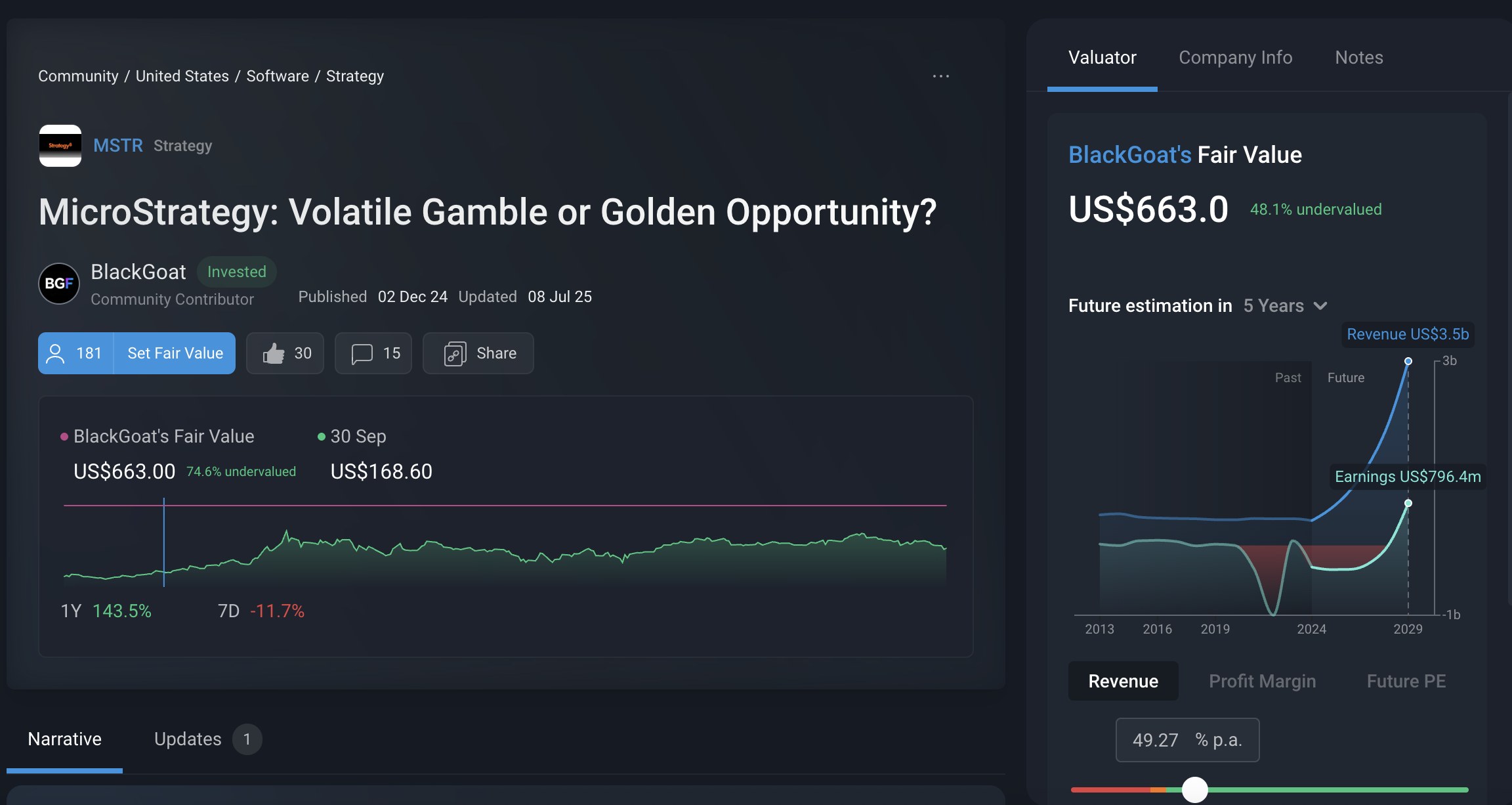
And investors in the community are discussing exactly this, too. Check out this narrative on Strategy that discusses the company, its mNAV, and what could be in store going forward.