Your login is via your account |
|
|
🦾 Finding Opportunities In The Robotics Revolution
This week we are back to our series on innovation and disruption, after a brief detour to honour Warren Buffett’s career. Specifically, we are looking at the field of automation and robotics. Automation comes in many forms: autonomous vehicles and drones, AI agents, automated assembly lines, and humanoid robots. They all have two things in common. Firstly, they are all powered by AI. And secondly, they have significant tailwinds behind them. If you want to invest in the big trends shaping the future, this is one of the most important ones to explore. |
|
|
Quote of the week “The first rule of any technology used in a business is that automation applied to an efficient operation will magnify the efficiency. The second is that automation applied to an inefficient operation will magnify the inefficiency.”
Bill Gates
|
What Happened In The Markets This Week? Here’s a quick summary of what’s been going on: 🏙️ Main Street isn’t very optimistic (Axios) - Small business optimism dropped for a fourth straight month in April, with investment plans at their lowest since the early COVID lockdowns.
- The NFIB survey shows Main Street is spooked by unstable economic conditions, especially the whiplash from shifting U.S. tariff policy.
- Lower capital spending from small firms (the economy’s job engine) hints at weaker near-term GDP growth and softer demand for B2B suppliers, industrials, and regional banks. Even with some sales gains, businesses aren't buying into a better future just yet.
- Some investors are reducing their exposure to small-cap cyclical stocks and considering defensive sectors. Main Street’s retreat could be an indicator of weakness ahead for growth-sensitive stocks.
🤝 What the U.S.-China Trade Agreement Means for Markets (WSJ) - Monday's rally may have been about more than just tariffs.
- For those of you who missed it: the U.S. and China agreed to a 90-day tariff rollback, and U.S. tariffs on Chinese goods drop from a punitive 145% to 30%, while China's retaliatory duties fall from 125% to 10%.
- But possibly more important is that Treasury Secretary Scott Bessent, seen as more pragmatic than Trump, now appears to be steering trade policy, and investors liked that.
- Markets are betting this 90-day truce could evolve into deeper structural talks aimed at long-term trade rebalancing with China.
- Lower near-term tariff risks reduce stagflation fears and restore dollar confidence, which is bullish for equities but bearish for gold. A more predictable policy hand (Bessent) would also likely boost investors' risk appetite, especially for global cyclicals and exporters.
- With Bessent at the helm, analysts are expecting less chaos and more coherence. That’s good news for equity bulls and anyone long the dollar.
📈 Coinbase joining S&P 500 days after bitcoin soared past $100,000 (CNBC) - Coinbase is set to join the S&P 500 on May 19, replacing Discover Financial as it gets acquired by Capital One.
- The news comes just days after bitcoin broke above $100,000 and Coinbase announced a $2.9B acquisition of crypto derivatives exchange Deribit.
- S&P 500 inclusion means passive inflows and institutional legitimacy, which is a short-term tailwind for COIN. But the stock’s volatility and lag behind BTC highlight ongoing investor caution, especially post-2021 highs.
- Expect near-term buying pressure from index funds, but don’t chase COIN blindly. Its fate is still tied tightly to crypto sentiment and price action.
To see our take on these and other market stories, simply check out the full article! 🕵️♂️ UnitedHealth under criminal probe for possible Medicare fraud, report says (Reuters) 🇺🇸 US agrees to sell Saudi Arabia $142bn arms package (Reuters) ✈️ Boeing inks record-breaking deal for Qatar Airways to buy up to 210 planes (CNBC) Now let’s dive into the main piece! |
🤖 The Next Leg Up In Automation and Robotics Humans have been automating repetitive tasks for centuries. From inventing the printing press in 1440, the “spinning jenny” (textile manufacturing) in 1764, to steam engines in the 1700s, we have a knack for creating increasingly clever ways of doing more with less. Nowadays, the tailwinds behind automation are stacking up faster than ever. Several technologies are converging and turning 1970s science fiction into reality: - 🧠 Artificial Intelligence (AI) and Machine Learning (ML):
- AI makes robots smarter, more adaptable, and capable of complex, non-repetitive tasks. ML allows machines to learn from data and improve.
- 🌐 Internet of Things (IoT):
- Increased connectivity lets robots and automated systems communicate seamlessly, enabling smarter factories and supply chains.
- 🔋 Battery Storage:
- Allows autonomous vehicles, drones, and robots to operate longer before a recharge.
- 👁️ Improved Sensors and Vision Systems:
- Advanced sensors like LiDAR and high-def cameras give robots a better understanding of their environment for safer, more sophisticated interactions.
- 📉 Falling Costs:
- Robots and components are getting cheaper, making automation accessible to more industries, including small and medium-sized businesses.
While technology is making more possible on the supply side, demographic and geopolitical factors are fueling demand: - 🧑⚕️ Labor Shortages & Demographics:
- Aging populations and shrinking workforces in developed countries create persistent labor gaps. Automation helps fill these and maintain productivity.
- ⚙️ Quest for Efficiency:
- Companies globally need to cut costs, boost quality, and improve efficiency. Robotics offers precision, speed, and endurance.
- 🏭 Reshoring & Supply Chain Resilience:
- The supply chain issues of 2021, and even recent tariff turmoil, highlighted supply chain vulnerabilities. If governments want to bring manufacturing “home” or businesses want to diversify their supply chains, automation is crucial.
- 🏠 Consumer Acceptance:
- Robotics is moving beyond factories and into the home, as consumers become more comfortable with technology.
✨ Over and above these points, automation reduces costs, which brings prices down and makes products affordable to a larger market. While low-paying jobs are lost, new, higher-paying jobs are created. |
|
|
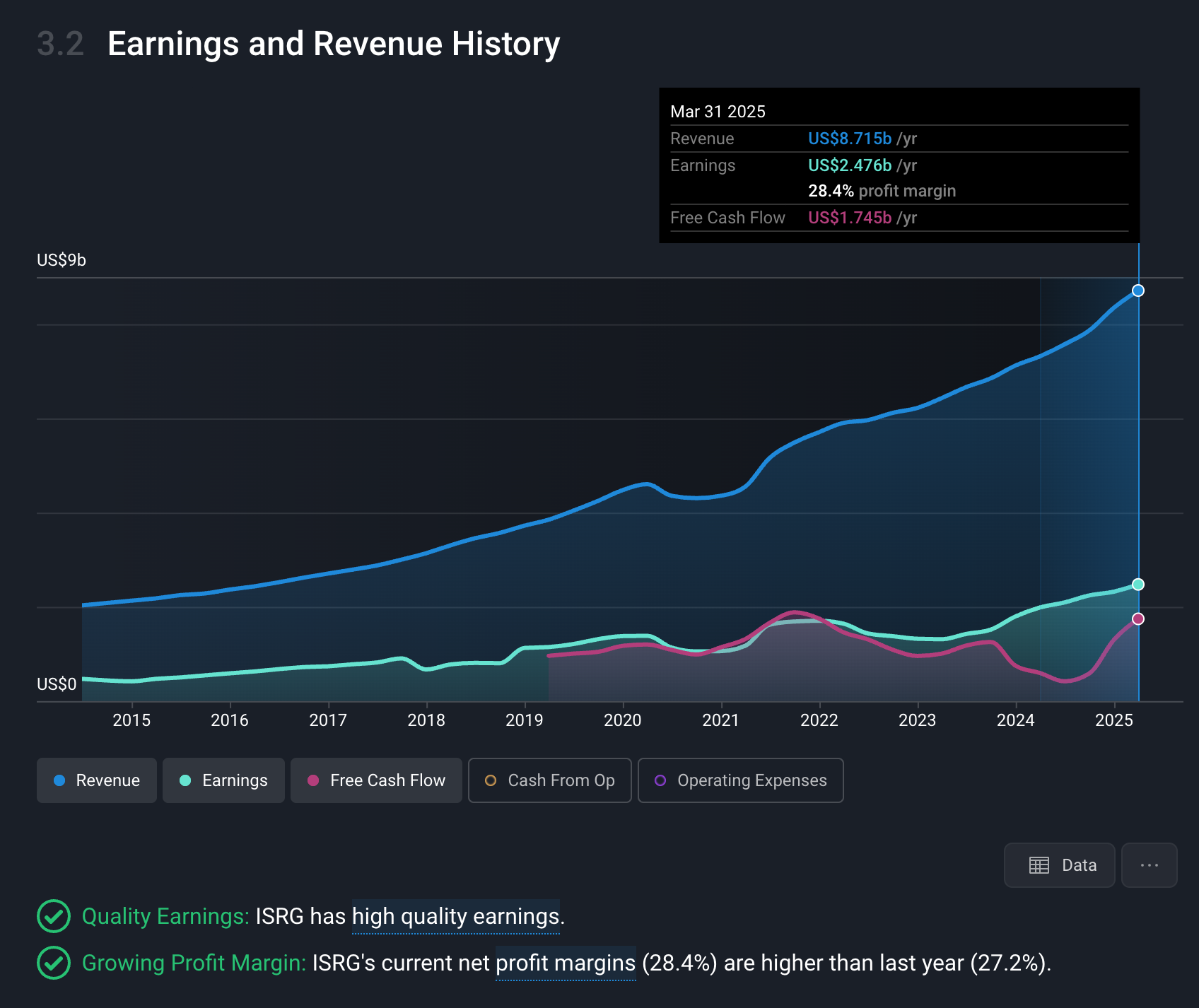
🧩 There are 7 large segments in the automation industry. For those interested, we go into depth on each of them and the stocks within each in the full article: 🏭 Industrial Automation 🤖 Humanoid Robots 🧑💻 Process Automation 🐕🦺 Service Robotics 🚕 Autonomous Vehicles & Robo-taxis 🛩️ Drone Technology (UAVs) Other Applications (Space, Defense, Security, etc) We cover specific examples like Daifuku and Intuitive Surgical, who have grown their revenues consistently for the last 10 years. |
🛠️ The Automation & Robotics Ecosystem Much like the AI and semiconductor industry, there’s a much larger ecosystem supporting the development of automation and robotics technologies. Component Manufacturers (The "Picks & Shovels"): - Sensors (vision, LiDAR, force/torque).
- Actuators & Motors.
- Controllers & Processors.
- End-effectors/Grippers.
- Semiconductor and electronic component companies are key here. Special mention should be made for Nvidia, as enabling robotics is a key objective for the company.
🧑💻 Software and AI Developers: - Robot Operating Systems (ROS) & Control Software: Platforms for robot apps.
- Machine Learning & AI for Robotics: Algorithms for perception, navigation, decision-making. The "intelligence."
- Simulation & Digital Twin Technology: Virtual design, testing, and optimization.
🔀 System Integrators & Solutions Providers: - Design and implement complete robotic solutions for end-users, combining robots, software, and components.
🛜 Enabling Technologies: - IoT & Connectivity (e.g., 5G): Seamless communication.
- Cloud Robotics: Cloud computing for data, processing, shared learning.
- Cybersecurity for Robotics: Protecting connected, autonomous robots.
🌍 Geographical Focus: Where are the Robotics Hotspots? The automation and robotics sector has notable geographical diversity, which makes a nice change given the dominance of US companies in most sectors. - 🇺🇸 USA
- Strong in AI, software, AVs (Waymo, Tesla), surgical robotics (Intuitive Surgical), and logistics automation.
- 🇯🇵 Japan
- A traditional industrial robotics powerhouse (Fanuc, Yaskawa); pushing service robots for elder care.
- 🇩🇪 Germany
- Known for "Industrie 4.0" and strong in industrial robotics (KUKA) for manufacturing.
- 🇨🇳 China
- A rapidly growing force in robot production and adoption, backed by government support. Big in AI, drones (DJI).
- 🇰🇷 South Korea
- High robot density in electronics manufacturing.
- 🇨🇭 Switzerland
- Hub for precision engineering, cobots (ABB).
- 🇨🇦 Canada
- Growing AI research, strengths in industrial automation components.
- 🇬🇧 UK
- Strong academic research, emerging niche companies.
|
🔍 Finding Investment Opportunities In Automation There are hundreds of listed companies involved in the robotics revolution in one way or another. ✨ As is often the case, checking the holdings of thematic ETFs is one way to find companies you may not have heard of. Often, these types of ETFs take a very broad view when deciding which companies qualify for inclusion. The following ETFs actually do a good job of sticking to what the label says. Better yet, they include companies from around the globe, so you aren’t limited by your home market. Here are a few: - VanEck Robotics ETF (IBOT)
- Global X Robotics & Artificial Intelligence ETF (BOTZ)
- Global X Global Robotics & Automation Index ETF (ROBO)
- Pacer BlueStar Engineering the Future ETF (BULD)
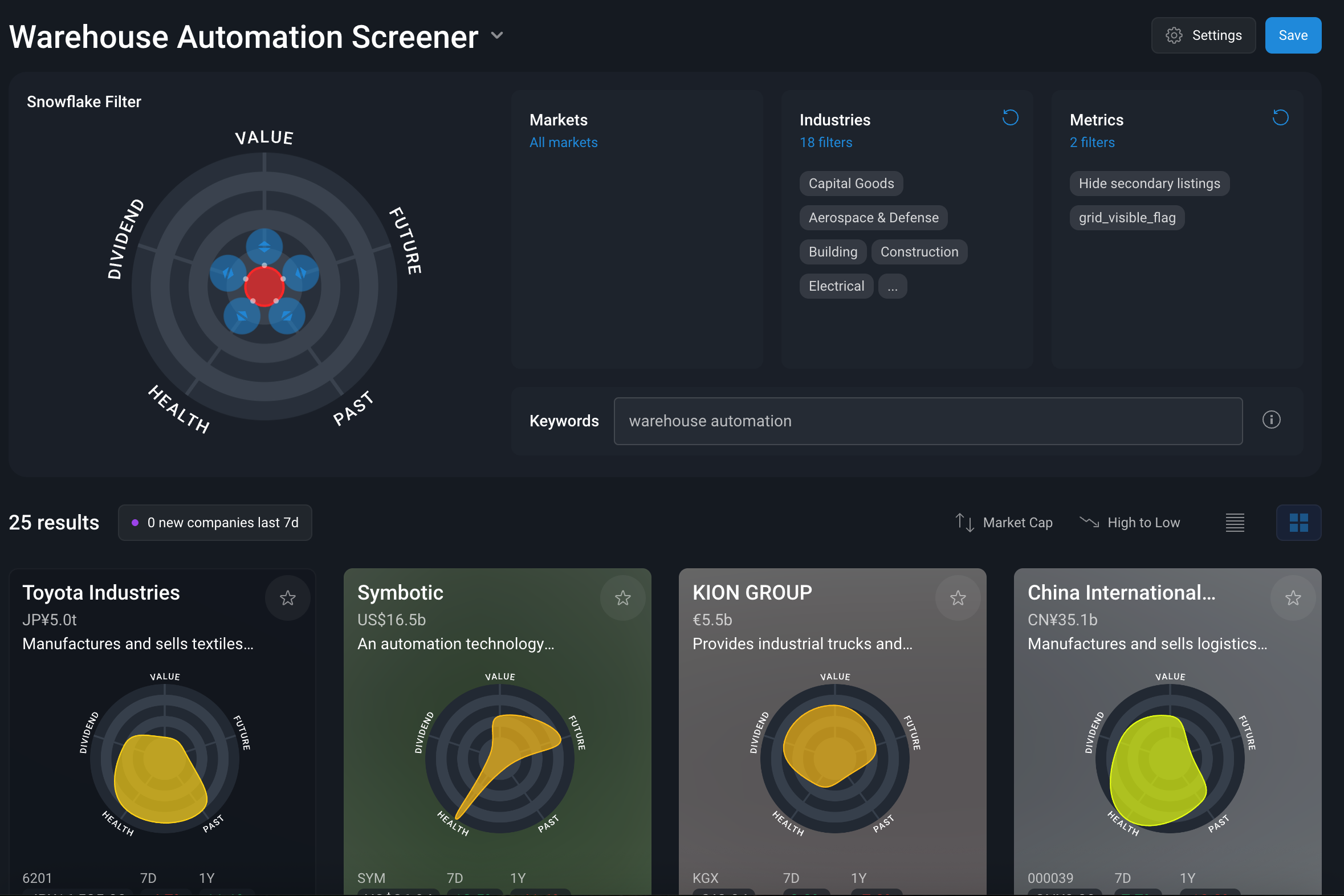
You can check the largest 15 holdings in these ETFs by clicking the ticker symbols above which will take you to the ETF database VettaFi. You can also use the Simply Wall St Stock Screener to find niche companies that may be overlooked. Besides filtering by Country, Industry and Sector, and Financial Metrics you can also search using Keywords. This is especially useful for a diverse theme like robotics. Since "robotics" isn't always a distinct industry classification, use keywords in the company description search. - 🚚 Identifying "Logistics Automation" Players: Search "Industrials" or "Software" with keywords like "warehouse automation," "logistics robots," or "AGV."
- 🩺 Uncovering "Surgical Robotics" Companies: Use keywords "surgical robot" or "robotic surgery," as they might not all be in "Healthcare Equipment."
- The screener below lists companies that include ‘warehouse automation’ in their profile.
|
|
|
💡 The Insight: Diversify Your Bets Across the Automation & Robotics Ecosystem
There are already some exciting companies in the robotics space, and more are likely to emerge in the next decade. Humanoid robots and flying cars are cool and all, but will they deliver for investors? If you think about the demand side of things, the industry does have a lot going for it. There are a few things to keep in mind with these types of companies: - 💰 Robotics is very capital-intensive. Not only do these machines need GPUs to power their ‘brains’, but moving parts need to be developed, built, and tested.
- 📅 Breakeven delays: There’s a good chance reaching breakeven will take longer and cost more than anticipated.
- 📊 Lower Margins: They aren’t software stocks with 80% gross margins either.
- 🤑 Raising more capital: Companies developing these technologies often need to raise new capital, and to do that, they’re likely to present the most rose-tinted outlook they can.
✨ All of this needs to be considered when assessing the companies that are prone to being over-hyped. This doesn’t mean you should avoid the disruptors and innovators, but there are lots of ways to hedge your bets. This industry stands to benefit from strong secular trends for a long time. As we mentioned last week, Warren Buffett generated great returns investing in companies that compounded slowly and steadily. The robotics and automation industry includes innovators, companies with decades-long track records, and, of course, all the other companies in the value chain. |
|
|
💬 Join the discussion by leaving a comment!
Are you invested in the massive secular trend of automation and robotics? |
|
|
Key Events Next Week Here’s some data releases to keep an eye on next week: Tuesday - 🇦🇺 RBA Interest Rate Decision
- 📊 Forecast: 3.85%, down from 4.1%
- ➡️ Why it matters: Australia’s economy needs some relief on rates. Lenders are already cutting rates in anticipation of a 0.25% cut, while some economists are calling for a 0.5% cut.
- 🇨🇦 Canada Consumer Price Index (YoY)
- 📊 Forecast: 2.5%, Previous: 2.3%
- ➡️ Why it matters: Canada has effectively suspended most retaliatory tariffs on US imports, but economists still expect some inflationary pressure in the near term.
Wednesday - 🇯🇵 Japan Balance of Trade
- 📊 Forecast: ¥ -200.0 billion, down from ¥ 544.1 billion
- ➡️ Why it matters: Japan’s trade balance was abnormally high in February and March, possibly due to front-running of tariffs. It’s believed to have swung to a deficit in April.
- 🇬🇧 United Kingdom Consumer Price Index (YoY)
- 📊 Forecast: 3.3%, up from 2.6%
- ➡️ Why it matters: The expected increase in prices will be bad news for consumers and businesses hoping for more rate cuts.
- 🇺🇸 United States Existing Home Sales
- 📊 Forecast: 3.9 million, down from 4.02 million
- ➡️ Why it matters: Home sales data could provide insights about the effect ‘Trumpanomics’ is having on the housing market.
Thursday - 🇪🇺 Eurozone HCOB Manufacturing PMI (Flash)
- 📊 Forecast: 49.2, up slightly from 49
- ➡️ Why it matters: This isn’t a widely followed indicator, but it is regarded as a leading indicator for business sentiment. This is particularly relevant given the current economic uncertainty.
We’re now in the back half of Q1 earnings season, which means most of the notable companies reporting are retailers and software companies: - Home Depot
- Intuit
- PDD Holdings
- TJX Companies
- Lowe's Companies
- Palo Alto Networks
- Analog Devices
- Medtronic
- Workday
- Autodesk
- Snowflake
- Target Corporation
- Baidu
|
Until next week, invest well. Simply Wall St |
|
|
| | | Download the app | | | This email is from Simply Wall Street Pty Ltd
Level 5, 3 20 Pitt St Sydney 20 00, NSW, Australia. | | Simply Wall Street Pty Ltd (ACN 600 056 611), is a Corporate Authorised Representative (Authorised Representative Number: 467183) of Sanlam Private Wealth Pty Ltd (AFSL No. 337927). Any advice contained in this email/website is general advice only and has been prepared without considering your objectives, financial situation or needs. You should not rely on any advice and/or information contained in this website and before making any investment decision we recommend that you consider whether it is appropriate for your situation and seek appropriate financial, taxation and legal advice. Please read our Financial Services Guide before deciding whether to obtain financial services from us. | | | Don’t want to receive Market Insights? Unsubscribe
Want to stop receiving emails or check which emails you are subscribed on? Manage email preferences | | |
| |
|
|