Your login is via your account |
|
|
8th - 14th September 2025 |
| |
|
💸 Finding Quality Dividend Yields in a Rate-Cutting Environment
The bond market’s been on a wild ride over the past 12 months with lots of noise, lots of movement… and now we’re basically right back where we started. The market has already priced in a 25bps rate cut from the Fed next week like it’s a done deal. So this week, we’re zooming in on what’s really been going on in the bond market, and what it all means for dividend investors who want to maintain yield. The outlook is still murky. But don’t worry, we’ll walk you through a few smart ways to steer clear of the most likely yield traps out there with screeners to find high-quality dividend stocks. 🎧 Would you prefer to listen to these insights? You can find the audio version on our Spotify, Apple Podcasts or our YouTube! (Released each Monday by 5pm AEST). |
|
|
Quote of the week
“While we can learn from the long run about how bonds and stocks respond to changing environments and to each other, the long run can tell us perilously little about what kinds of environments lie ahead.” Peter Bernstein
|
|
|
What Happened In The Markets This Week? Here’s a quick summary of what’s been going on: ✂️ Dismal Jobs Report Fuels Expectations of Faster Rate Cuts (WSJ) - August’s weak jobs report locked in a September Fed cut and shifted market bets toward consecutive quarter-point cuts through December. Odds of three straight moves are now around 75%, with 2-year yields dropping to a three-year low.
- Inflation is the sticking point, still running above target, keeping some officials cautious about cutting too aggressively.
- Traders see policy easing accelerating, but the Fed must balance softer hiring with sticky prices. More cuts could support equities and credit, though inflation surprises risk forcing a slower pace.
- Jobs are weakening, markets are leaning dovish, and the Fed is preparing to move, but inflation will decide the throttle.
💬 Robinhood Aims New Social Platform at Reddit’s WallStreetBets (Bloomberg) - Robinhood is building its own version of WallStreetBets, launching a social platform where users can post trades, track each other’s performance, and even follow high-profile investors like Nancy Pelosi.
- All posts must be tied to real-time trades, giving Robinhood a credibility edge over Reddit’s screenshot method and more control over the investing conversation.
- This is less about community and more about retention. By locking users into its ecosystem with social features, Robinhood could boost engagement and time-on-platform, which are key metrics for monetization.
- Traders can also soon short stocks and trade index options overnight, signaling a push toward more sophisticated retail activity.
- Robinhood’s turning into a one-stop investing-entertainment machine. If it works, expect stickier users and possibly even more volatility from social-fueled trades.
To see our take on these and other market stories, simply check out the full article! 🏛️ Lutnick Says U.S. Should Take a Chunk of Universities' Patent Revenue (Axios) ☁️ Oracle’s Insane Cloud Infrastructure Forecast is Giving Shades of Nvidia’s Data Center Business (Sherwood) 📈 Klarna’s Stock Jumps 15% in NYSE Debut After Pricing IPO Above Range (CNBC) 🇲🇽 Mexico to Raise Tariffs on Cars From China to 50% in Major Overhaul (Reuters) Now let’s dive into the main piece!
|
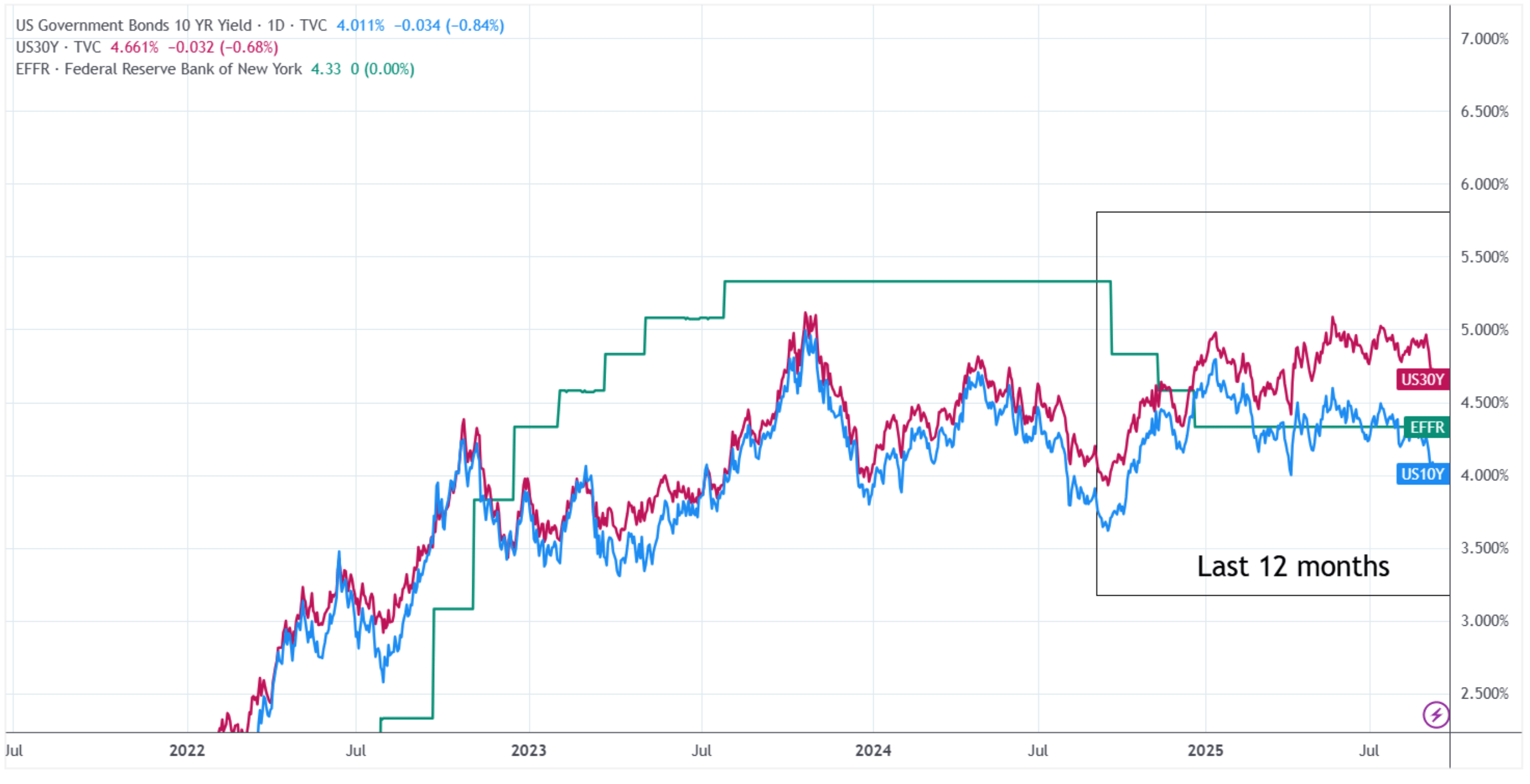
📈 Bonds, Yields & The Hunt for Income The past year has been nothing short of a rollercoaster for bond watchers. Sure, the biggest fireworks were back in 2022–2023 when inflation was roaring, but even as central banks started shifting gears, the ride didn’t exactly calm down. Take the U.S. for example: just as the Fed began cutting rates last year, bond yields did the opposite. |
US 10 and 30-Year Bond Yields vs Fed Funds Rate - TradingView |
Since late 2024, the Fed has been on pause, but as we mentioned in the news stories above, markets are betting that the cutting cycle resumes next week. As a quick reminder, bond yield movements are basically a tug-of-war between three forces: - ⚖️ Supply & Demand: More government borrowing = more bonds on the market.
- Total demand depends on who’s buying: either short-term “flight to safety” investors or big institutions holding for the long haul.
- 🏦 Central Bank Policy: When inflation heats up, rates typically rise to curb spending, which increases bond yields. When recession fears or crises occur, rates are typically lowered to encourage spending, and bond yields decrease.
- ⚠️ Perceived Risk: If debt looks unsustainable, investors demand higher yields as compensation for the risk they’re taking. Currency risk plays a role, too.
✨ Over the past 12 months, we’ve seen all of these dynamics at work. U.S. 10-year Treasury yields have been caught in a tug-of-war of competing storylines lately. - 🇺🇸 First, Donald Trump’s improving poll numbers and subsequent election win had markets bracing for higher inflation.
- 🤷 Then came the doubt, maybe he wouldn’t actually follow through.
- 💰 Cue “Liberation Day” (tariffs) and the “Big Beautiful Bill” (deficit spending), and suddenly inflation fears were back on center stage.
But since May, the script has flipped again: As a result of all that, yields on 10-year Treasuries have slid back to pre-“Liberation Day” levels. But the 30-year yield is still elevated, showing just how divided the market really is. - In the medium term, inflation fears are giving way to expectations of monetary easing.
- However, longer term, the elephant in the room is a mountain of US debt that just keeps growing.
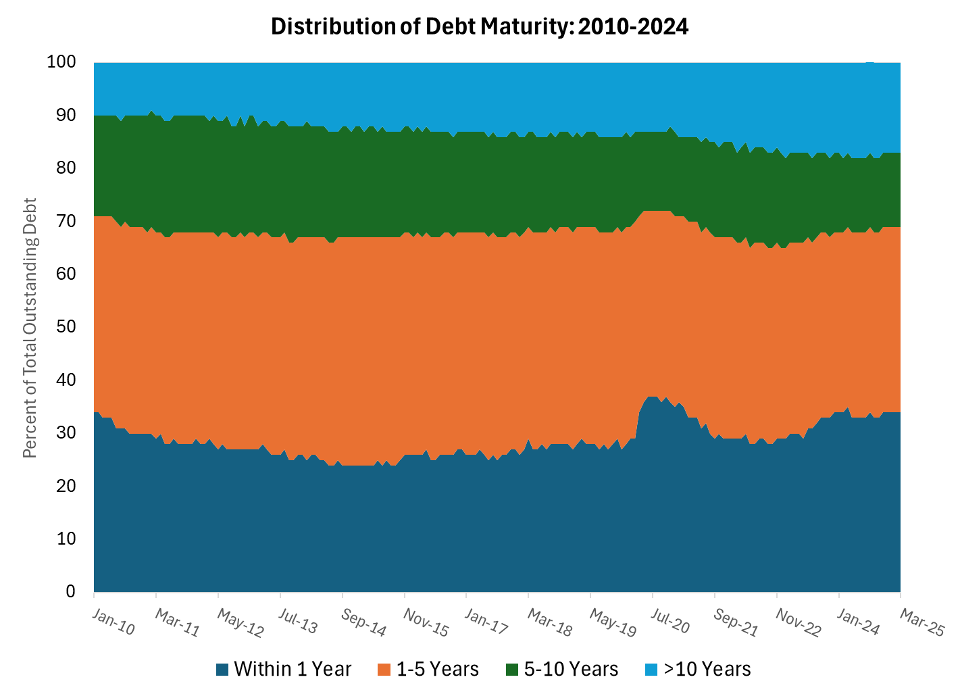
✨ Those buying longer-term US government bonds want more compensation for the perceived risk. Despite record borrowing, the US Treasury has limited issuance of longer-dated bonds. That means less supply (and less upward pressure on yields), but also less liquidity. ⚠️ And ultimately, the near-dated bonds will need to be refinanced. As of the most recent data from Q3 of FY2025, approximately 31% of U.S. publicly held marketable debt will be maturing within 12 months. While this chart below shows that the percentage (⅓ of total debt) maturing in less than 12 months is pretty typical, the issue nowadays is the amount. At today’s debt balance, ⅓ of the debt is around $10 trillion. |
Debt servicing costs now make up 22% of annual federal tax revenue, compared to around 11% in 2022. The government’s efforts to reduce interest rates are no doubt related to its intent to refinance this debt as cheaply as possible. |
These interest rate swings have kept income-focused investors on edge for the past few years. When “risk-free” government bonds yield 4–5%, dividend stocks yielding the same can lose their sparkle. But bonds don't offer as much upside potential as stock do. So our full piece covers:
How to use our analysis tools to avoid yield traps, 2 screeners to help you find compounding dividend stocks, and the 4 US stocks that meet our stringent high-quality dividend filters. |
|
|
💡 The Insight: More Uncertainty = More Reason to Diversify As mentioned in the full article, there’s a lot riding on upcoming economic data and on the Supreme Court decision on tariffs: With so much uncertainty, having all your eggs in one basket (i.e. sector) is a bit like playing roulette. Different backdrops favor different winners. A few areas to keep on the radar: - 🏦 Banks: Steeper yield curves = juicier margins.
- ⛽ Oil & Gas: Today’s oversupply could set up tomorrow’s tighter production. Plus, oil doubles as a hedge against global tensions.
- ⚡ Utilities: Electricity demand isn’t disappearing anytime soon.
- 📦 Govt-backed plays: Any sector with policy support is worth a look.
Final Note: Don’t FOMO the Dividend Chase You don’t need to chase every yield. If you want to wait for better entry points, the Vanguard Short-Term Treasury ETF currently yields over 4%. That’s better than earning nothing while waiting for better opportunities and entry points. |
|
|
💬 Join the discussion by leaving a comment!
What are your favorite dividend plays at the moment? |
|
|
Key Events During the Next Week Tuesday - 🇬🇧 UK Unemployment Rate
- ▶️ Forecast 4.7%, Previous 4.7%
- ➡️ Why it matters: Any uptick in unemployment would strengthen the case for more aggressive rate cuts.
- 🇨🇦 Canada Inflation Rate YoY (Aug)
- 📈 Forecast 1.8%, Previous 1.7%
- ➡️ Why it matters: With inflation below 2%, it would take a much bigger spike to warrant action from the central bank.
- 🇺🇸 US Retail Sales YoY
- 📉 Forecast 3.2%, Previous 3.9%
- ➡️ Why it matters: Falling retail sales will be further confirmation of a slowing economy.
Wednesday - 🇺🇸 US FOMC Interest Rate Decision
- 📉 Forecast 4.25%, Previous 4.5%
- ➡️ Why it matters: Fed fund futures imply a 92% chance of a 0.25% rate cut. The real impact will come from any hints about possible rate cuts in October and December.
Thursday - 🇬🇧 UK BOE Rate Decision
- ▶️ Forecast 4%, Previous 4%
- ➡️ Why it matters: UK inflation has risen steadily over the last year, and the BOE is expected to keep rates at 4% for now.
Friday - 🇬🇧 UK Retail Sales YoY (Aug)
- 📈 Forecast 1.5%, Previous 1.1%
- ➡️ Why it matters: This would be the third consecutive uptick in retail sales - good for the economy, but contributes to rising inflation.
Just a few notable companies reporting this week, but plenty of small caps: |
Until next week, invest well. Simply Wall St |
|
|
| | This email is from Simply Wall Street Pty Ltd
Level 5, 3 20 Pitt St Sydney 20 00, NSW, Australia. | | Simply Wall St has no position in the company(s) mentioned. Simply Wall Street Pty Ltd (ACN 600 056 611), is a Corporate Authorised Representative (Authorised Representative Number: 467183) of Sanlam Private Wealth Pty Ltd (AFSL No. 337927). Any advice contained in this email/website is general advice only and has been prepared without considering your objectives, financial situation or needs. You should not rely on any advice and/or information contained in this website and before making any investment decision we recommend that you consider whether it is appropriate for your situation and seek appropriate financial, taxation and legal advice. Please read our Financial Services Guide before deciding whether to obtain financial services from us. | | | Don’t want to receive Market Insights? Unsubscribe
Want to stop receiving emails or check which emails you are subscribed on? Manage email preferences | | |
| |
|
|