Your login is via your account |
|
|
✨Rare Earths: Tiny Market, Outsized Influence
Rare earths may be a sliver of the global metals market, but they punch far above their weight. These obscure elements are the invisible wiring of modern life. The problem is, China controls the chokepoint of refining, leaving the U.S. and its allies scrambling to secure supply chains. That scramble is now turning into action: Washington is writing billion-dollar checks, Australia is scaling up processing, and investors are chasing rare earth miners whose share prices have doubled or tripled. By the end of this piece, you’ll see why rare earths are less about market size and more about strategic leverage. Plus, we’ll cover how to tell which companies could benefit from the geopolitical arms race, and which are just along for the hype. 🎧 Would you prefer to listen to these insights? You can find the audio version on our Spotify, Apple Podcasts or our YouTube! (Released each Monday by 5pm AEST). |
|
|
Quote of the week
“Changing our energy model already means doubling rare metal production approximately every fifteen years. At this rate, over the next thirty years, we will need to mine more mineral ores than humans have extracted over the last 70,000 years.” Guillame Pitron, The Rare Metals War |
|
|
What Happened In The Markets This Week? Here’s a quick summary of what’s been going on: 🇺🇸The U.S. government shut down as Congress couldn’t reach a funding agreement (The Guardian) - The U.S. government has partially shut down again, but this time the stakes are higher. The White House is prepping for permanent layoffs, not just furloughs, and using the shutdown as a tool to shrink federal operations.
- Prolonged disruption could sap consumer confidence, delay federal spending, and weaken Q4 GDP – a potential drag on equities, especially in travel, retail, and defense.
- Bond investors should watch for delayed Treasury auctions or weaker demand amid dysfunction. Risk-off sentiment could push yields lower if the shutdown drags.
- Healthcare, media, and public infrastructure players tied to federal funding are particularly exposed to a drawn-out standoff.
- Political noise is also raising the risk of credit rating scrutiny. Another downgrade could spark market volatility.
🚢 Top shipping players want overhaul of UN ship fuel emissions deal (Reuters) - Top shipping firms are pushing back against the UN's proposed Net-Zero Framework, warning it could raise costs and create market distortions without delivering real emissions cuts.
- With the U.S. already threatening retaliation if the deal passes, investor risk around global trade, fuel prices, and port operations is climbing fast.
- If the framework is delayed or derailed, expect slower adoption of green shipping tech and more volatility in carbon credit markets tied to maritime fuel.
- Freight and logistics players like Mærsk, Hapag-Lloyd, and COSCO could face rising compliance uncertainty, while Air Products & Chemicals and Wärtsilä could benefit from new demand.
- Shipping regulation is becoming a geopolitical minefield. Watch for ripple effects in global inflation projections if shipping costs spike under future revised frameworks, and make sure you’re considering these policy risks in your future estimates.
To see our take on these market stories below, simply check out the full article! 🚗 Automakers are working accounting magic to extend the EV tax credit beyond its deadline (Sherwood) 💰 How the Electronic Arts takeover plays into Saudi Arabia's investment strategy (Axios) 📉 Share buybacks slow worldwide as U.S. tariffs take root (S&P Global) 📈 Robinhood joins the S&P 500 after remarkable rally (Yahoo) Now let’s dive into the main piece! |
🚀 Rare Earth Minerals: The Backbone of Modern Technology
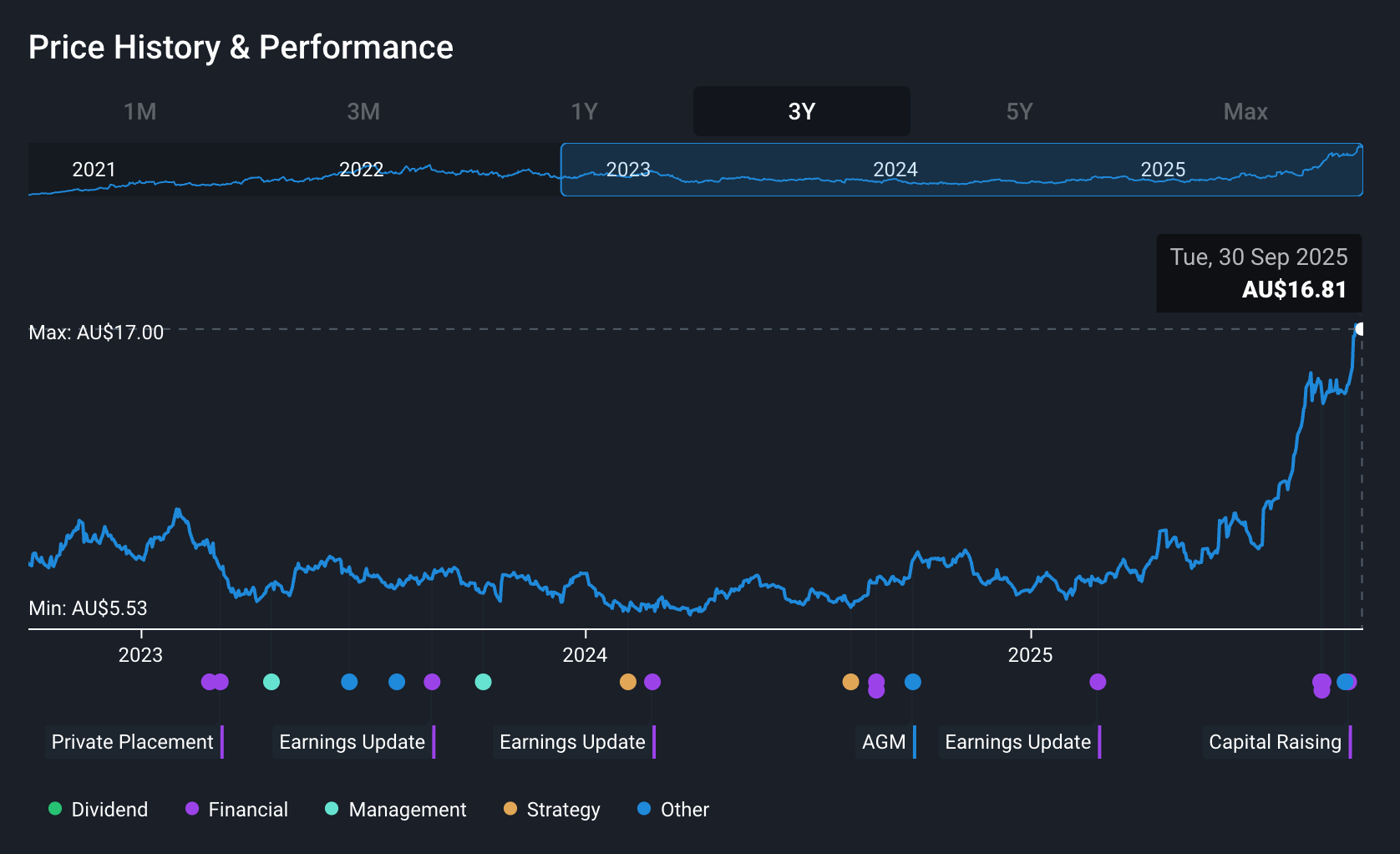
Rare Earth minerals have become a geopolitical football, but a lot more painful to kick. With the backing of the Trump administration, stock prices in this industry are flying. The largest non-China producers have seen their stock prices gain 100% to 200% in the last year alone, with smaller players up even more. Most of the charts look something like this: |
This list of 17 chemically similar rare earth elements (the REEs) is basically the VIP list for advanced tech. They’re what make your devices smaller, faster, and way more powerful. Some of the most valuable ones are: - Neodymium (Nd): The stuff that makes super-strong magnets.
- Dysprosium (Dy): It helps magnets handle heat, which makes them reliable in things like electric cars and computer hard drives.
- Cerium (Ce): Works like a scrubber in car exhaust systems, helping reduce pollution.
- Lanthanum (La): It’s added to metals to make them stronger and better for things like batteries, cameras, and hybrid cars.
So who needs them? Well, they’re indispensable for: - ⚡ Energy: Fuel cells, wind turbines, refining oil, and cleaning up exhausts.
- 🛡️ Defense: Guiding missiles and keeping satellite communication online.
- 💻 Computing: The guts of hard drives and key components in modern electronics.
- 🚗 Autos: From electric vehicle systems to essential brake components.
|
Rare earths may be a tiny $5B market, but they carry outsized geopolitical and technological weight. The real story isn’t scarcity, it’s refining, chokepoints, and government-backed supply chains reshaping the industry. So our full piece covers: 📋 The Critical Minerals list, and why REEs sit at the center of energy, defense, and chipmaking. ⚖️ Why the market is small in dollars, but massive in strategic leverage. 🇨🇳 How China turned refining into its ultimate bargaining chip, and why the West is scrambling to respond. 💰 How U.S. and Australian government deals are underwriting a new rare earths ecosystem, and what it means for investors. |
|
|
💬 Join the discussion by leaving a comment!
“Would you bet on rare earths as a strategic necessity, or avoid them as an overhyped niche market?” |
|
|
Key Events During the Next Week Tuesday - 🇦🇺 Westpac Consumer Confidence Change
- 📈 Forecast: 3.2%, Previous: -3.1%
- ➡️ Why it matters: A significant rebound in consumer confidence is a positive signal for future household spending and economic activity.
Wednesday - 🇦🇺 NAB Business Confidence
- 📈 Forecast: 9, Previous: 4
- ➡️ Why it matters: Stronger business confidence can lead to increased investment and hiring, signaling a robust outlook for the economy.
- 🇺🇸 FOMC Minutes
- ➡️ Why it matters: These minutes provide markets with deeper insight into the Fed's policy discussions and future interest rate path.
Friday - 🇨🇦 Unemployment Rate
- ▶️ Forecast: 7.1%, Previous: 7.1%
- ➡️ Why it matters: A stable unemployment rate suggests a steady labor market, giving the Bank of Canada room to hold policy.
- 🇺🇸 Uni. of Michigan Consumer Sentiment Index
- 📉 Forecast: 54.0, Previous: 55.1
- ➡️ Why it matters: Worsening consumer sentiment can signal a future slowdown in spending, which is a key driver of the U.S. economy.
This week is a mix of late Q2 and early Q3 quarterly financials. Q3 earnings season kicks off properly on the 14th with the big banks.
|
Until next week, invest well. Simply Wall St |
|
|
| | This email is from Simply Wall Street Pty Ltd
Level 5, 3 20 Pitt St Sydney 20 00, NSW, Australia. | | Simply Wall St has no position in the company(s) mentioned. Simply Wall Street Pty Ltd (ACN 600 056 611), is a Corporate Authorised Representative (Authorised Representative Number: 467183) of Sanlam Private Wealth Pty Ltd (AFSL No. 337927). Any advice contained in this email/website is general advice only and has been prepared without considering your objectives, financial situation or needs. You should not rely on any advice and/or information contained in this website and before making any investment decision we recommend that you consider whether it is appropriate for your situation and seek appropriate financial, taxation and legal advice. Please read our Financial Services Guide before deciding whether to obtain financial services from us. | | | Don’t want to receive Market Insights? Unsubscribe
Want to stop receiving emails or check which emails you are subscribed on? Manage email preferences | | |
| |
|
|