Viktor&Rolf
Viktor&Rolf is a Dutch avant-garde luxury fashion house founded in 1993 by Viktor Horsting and Rolf Snoeren, renowned for provocative haute couture designs, conceptual glamour, and bestselling fragrances including Flowerbomb and Spicebomb.

-
Viktor&Rolf · Jul 12
-
Viktor&Rolf · Jul 09
-
Viktor&Rolf · Jul 05
-
Viktor&Rolf · Jun 23
-
Viktor&Rolf · Jun 21
-
Viktor&Rolf · Jun 16


Viktor&Rolf customer service
Use any of the convenient means below to contact Viktor&Rolf customer service.
| Phone | (866) 408-6191 |
| Web | https://www.viktor-rolf.com/en-us/pages/contact-us |
| [email protected] |

Headquarters
Danzigerkade 55
1013 AP Amsterdam, The Netherlands
[email protected]

Returns
What is the return window?
Viktor&Rolf offers free returns and exchanges within 14 days from the delivery date for any item bought on viktor-rolf.com. For the US fragrance website, we accept returns of any Viktor&Rolf purchase within 30 days of the transaction.
Are there any items that are non-returnable?
For fragrances (EU & UK Only), we do not offer free returns. Customers are responsible for arranging and covering the cost of returning fragrance items. Fragrances must be unused and sent back in their original packaging and shipping box. There is a no return policy on all lingerie and underwear purchases for hygiene reasons. Final sale items, engraved items, promotional gift items, and e-gift cards are not eligible for return.
How will I receive my refund?
Purchase by Credit/Debit Card: refund time will depend on the Credit Card company's policies. We would like to assure you, however, that the value date for the credit will coincide with the date of the original payment; therefore, you will not suffer any interest loss. Upon receipt of the package, the return process can take 1-2 business days to complete and 3-5 business days to post onto your account. Order credit will be issued to the original payment method and you will be notified by email.
Who pays for return shipping?
Viktor&Rolf offers free returns and exchanges within 14 days from the delivery date for any item bought on viktor-rolf.com. Free returns and exchanges are available worldwide for all our Ready-to-Wear (RTW) collections online. For US fragrances, simply click here to initiate a return and generate a pre-paid label.

Editor's Take
So here's the thing about Viktor&Rolf - they're basically what happens when two Dutch art school grads decide fashion should be more like performance art, and somehow it actually works.
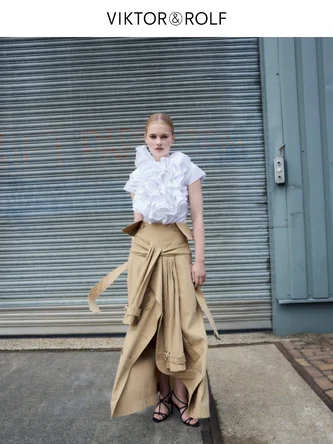
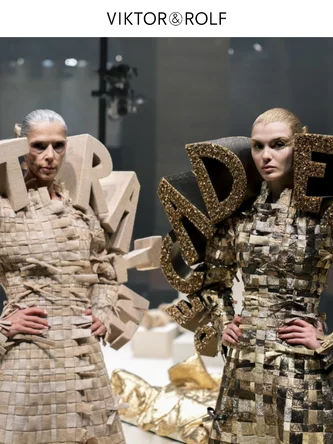
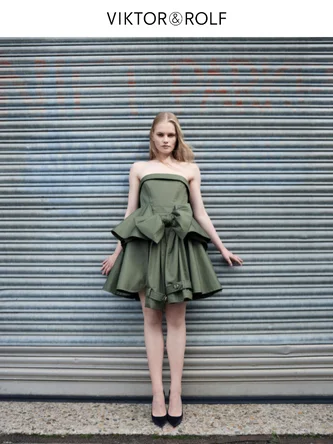
Viktor Horsting and Rolf Snoeren founded their avant-garde luxury fashion house in 1993, and they've been messing with our expectations ever since. These guys literally create dresses from red carpet material, send models down runways wearing what looks like oil paintings, and design collections where garments hang upside down or sideways off the body. It's wild, conceptual stuff that makes you question where clothing ends and art begins.
But here's what's interesting - initially, Viktor & Rolf were shunned by the fashion industry, however, the designers were received well by the art world. Art institutions such as the Groninger Museum began to acquire garments from the designers. Kind of poetic, right? The fashion world didn't want them, so museums started collecting their work instead.
Since 2008, Viktor&Rolf has been part of the OTB Group, which also owns Diesel and Maison Margiela. And while their haute couture gets all the headlines - those theatrical Paris Fashion Week shows with their surreal silhouettes and provocative concepts - Viktor & Rolf also created perfumes; the female fragrances Flowerbomb (2004) and Bonbon (2014), along and the male fragrances Antidote (2006) and Spicebomb (2012). Flowerbomb alone has become a massive bestseller, which is kind of ironic considering how niche their fashion is.
The brand's trajectory is fascinating. In 2015, the designers halted ready-to-wear production and returned once more to haute couture citing that they wanted to "explore the limits of wearability, function and form." Most brands go the opposite direction - starting with couture and moving to ready-to-wear for commercial viability. Viktor&Rolf basically said "nah, we're going back to the weird stuff."
Their collections have names like "Wearable Art," "Red Carpet Dressing," and "Scissorhands" - each one a conceptual exploration that's equal parts fashion show and art installation. They've made dresses entirely from tulle with aggressive social media slogans appliquéd on them, created latex couture pieces designed to look like a second skin, and literally cut up perfectly finished garments with scissors on the runway to explore "decorative cutting."
What makes them relevant beyond the fashion bubble is their fragrance business. While haute couture is inherently exclusive - we're talking pieces that cost tens of thousands of dollars and are worn by maybe a few dozen people worldwide - their perfumes bring that Viktor&Rolf aesthetic to a much wider audience. You can't afford a $50,000 couture gown, but you can experience their creative vision through a bottle of Flowerbomb.
The brand also does bridal wear through Viktor&Rolf Mariage, which is available at select retailers worldwide, and they've got an eyewear line called Viktor&Rolf Vision. So there's this interesting tension between their ultra-conceptual runway work and these more accessible product categories.
One thing that stands out - for more than twenty years, Viktor & Rolf have sought to challenge preconceptions of fashion and bridge the divide between fashion and art. And they've actually succeeded. Their work has been exhibited at the Metropolitan Museum of Art, the Barbican Art Gallery, and museums across the globe. That's not common for fashion designers.
The duo's approach is refreshingly consistent. They're not trying to be commercial. They're not chasing trends. They're just doing their thing - making clothes that provoke, surprise, and sometimes confuse. And in an industry that often feels like it's just recycling the same ideas, that kind of singular vision is pretty rare.