Aida Bicaj - May 11, 2026
What It Takes To Earn A Place At Aida Bicaj
Most of the brands I carry, you have never seen advertised.

What It Takes To Earn A Place At Aida BicajMost of the brands I carry, you have never seen advertised. That is not an accident. It is the first thing I look for.
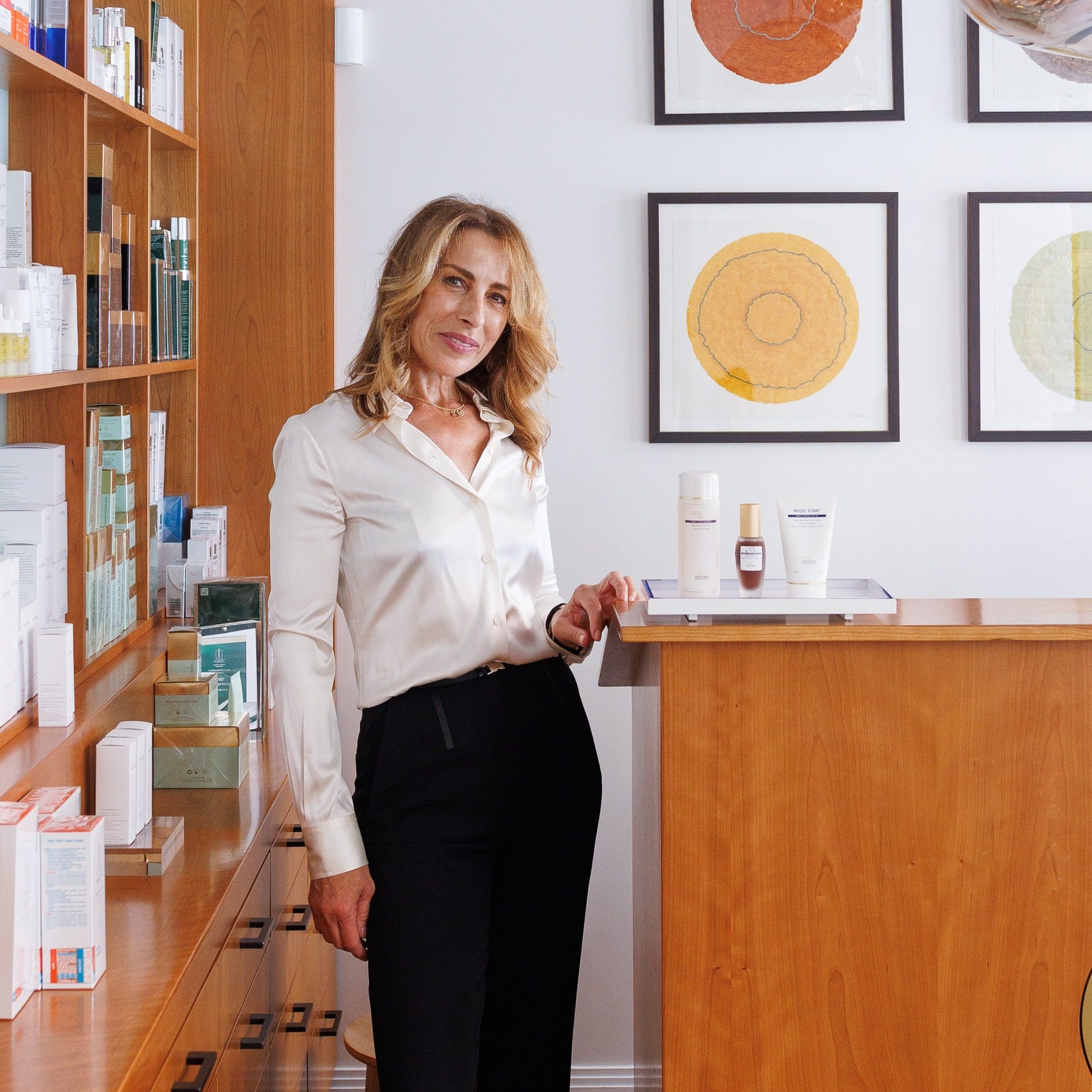
When a brand is spending heavily on marketing: on influencer seeding, on glossy campaigns, on the kind of ubiquity that makes a product feel unavoidable, I start asking what the budget is not going toward. Research. Formulation. The slow, expensive work of actually understanding how skin functions and what it needs. Marketing and science are not mutually exclusive, but in my experience, the brands that lead with one tend to underinvest in the other. The lines I trust are the ones you find because someone who knows skin told you about them. They travel by word of mouth. They do not need to shout. When I feel the industry moving in a direction I don’t trust, I go back to the roots. Skincare is accelerating. New ingredients, new technologies, new categories invented and abandoned within a single season. There is always something newer, something that promises more, something designed to make last year’s routine feel obsolete. I have watched this cycle long enough to know that most of what it produces is noise. The fundamentals of skin have not changed. The biology has not changed. What the skin needs to function well, to repair itself, to age with integrity, that has been understood for a long time by people who were paying close attention. I am not afraid to return to that. I am not afraid to be slower than the market, or quieter, or less impressed by what is new. If the direction the industry is heading does not serve the skin, then the direction I am heading is back toward what does. The second thing I look for is results, but not the kind the industry has trained consumers to expect. We have built a culture around instant transformation. The overnight miracle. The serum that visibly changes your skin in 72 hours. I understand the appeal. I also understand what is usually behind it: occlusive agents that temporarily plump the surface, ingredients that cause a mild inflammatory response the skin reads as tightness or brightness, optical diffusers that catch light in a flattering way. None of that is lasting. None of it is repair. What I am looking for is cumulative change. Skin that functions better over weeks and months. A barrier that holds. Texture that refines steadily rather than dramatically. Reactivity that decreases. Those results are quieter and they take longer, but they are the ones that tell me a product is actually doing something at the level of the skin’s biology rather than performing for the mirror. Baume 27 Advanced Formula is one of the clearest examples I can point to, clients who use it consistently for sixty days have different skin. Not temporarily different. Actually different. The third thing I look at is the ingredient quality and how the product is made. Not all ingredients are created equal, and sourcing matters in ways that are rarely communicated on a label. The concentration matters. The delivery system matters. Whether the active has been studied in its finished formulation or only in isolation matters. I want to know where the raw materials come from, how they are processed, and whether the manufacturing is held to a standard that preserves the integrity of what is in the formula. A beautiful ingredient list means very little if the production process degrades it before it reaches the skin. Essence 27 is 99% natural origin — that number only means something if the sourcing behind it is serious, and with Cosmetics 27, it is. Huile 27 is built on seven botanical oils selected specifically for their Omega 3 and 6 content and their ability to restructure the hydrolipidic film. The formula is 99.5% natural origin and 98% active ingredients. That ratio is nearly unheard of. This is part of why I spend time in the places where the work is done. The trip to Normandy with Mansard was not a press event. It was a chance to see how a line is built from the inside: the sourcing decisions, the philosophy behind the formulation, the standard of care that goes into something before it is ever put in a jar. Serum No. 23 Vita-C is a product I came back from that trip recommending to nearly every client dealing with uneven tone or oxidative stress. I understood it differently after seeing where it came from. That kind of access changes how you understand a product. It also changes how you recommend it. The last thing I look for is the science, and I mean actual science, not science as an aesthetic. The industry has learned to dress things up in clinical language. Percentages and patent names and before-and-after photography can all be constructed to look rigorous without being rigorous. What I am looking for is a coherent biological rationale. A mechanism of action I can trace. Studies that were designed to test something specific rather than to confirm a conclusion the brand had already decided on. Not every brand I carry has published peer-reviewed research, some of the most serious work in skincare happens in private labs that do not publish, but the reasoning has to hold. I have to be able to understand why this product does what it does, and I have to believe it. Biologique Recherche earned its place in my practice decades ago. Cosmetics 27 earned it quietly, without ever asking me to promote it. Mansard earned it in a room in Normandy where I watched how seriously they take the work. None of them asked me to trust them. They gave me reasons to. That is the only way it works.
Aida's Substack is free today. But if you enjoyed this post, you can tell Aida's Substack that their writing is valuable by pledging a future subscription. You won't be charged unless they enable payments.
|