About the Book
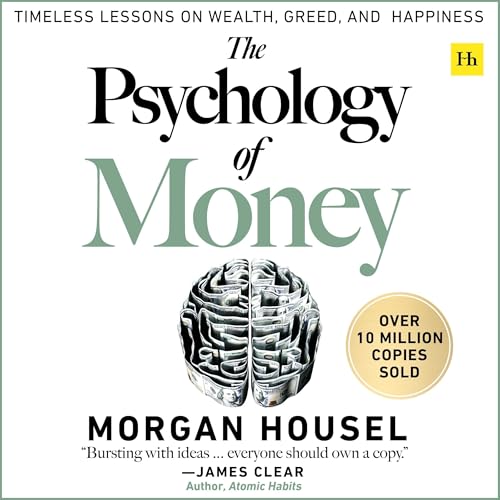
The Psychology of Money by Morgan Housel is a personal finance book that takes a different angle than most in the genre. Rather than explaining how compound interest works or which index funds to pick, Housel focuses on the psychological and behavioral side of financial decision-making, why people make the choices they do with money, and why smart people so often get it wrong.
The book is structured as a series of short chapters, each built around a distinct idea or principle. Topics range from the role of luck and risk in wealth-building to how our relationship with money is shaped by when and where we grew up. There's no single thesis being argued across 300 pages, it reads more like a collection of connected essays, each making a self-contained point.
This is not a how-to guide. You won't finish it knowing exactly which stocks to buy or how to structure your retirement account. What it offers instead is a framework for thinking about money more clearly, recognizing your own biases, understanding why saving matters more than returns for most people, and separating genuine financial skill from luck dressed up as skill. It has sold over 10 million copies worldwide and spent time at the top of the Sunday Times bestseller list, so it has clearly connected with a wide audience.
Narration & Audio Performance
Chris Hill narrates the audiobook in a measured, conversational tone that suits the essay format of the book well. He doesn't perform the material, he reads it clearly and steadily, which is appropriate for a book that's essentially one person sharing their considered opinions. The pacing is easy to follow and doesn't feel rushed.
Because the chapters are largely self-contained and not heavily data-driven, the lack of a dramatic or character-driven narration style isn't a problem here. Hill keeps things moving without becoming monotonous. There are no charts or tables being read out, which is one of the risks with business and economics titles. The prose itself is fairly clean, and Hill's delivery respects that without adding unnecessary emphasis.
That said, if you're someone who tends to underline and annotate as you read, the print or Kindle version may serve you better for retention. The audiobook is a comfortable listen, but Housel's ideas are the kind you'll want to revisit, and navigating back to a specific chapter is easier in print than in audio.
The Audible Verdict
The Psychology of Money is a good book and the audiobook is a reasonable way to get through it, particularly for commutes or long drives. Chris Hill's narration is clear and unobtrusive. But the format adds no particular advantage over print here, and the essay-style structure means you may want to flip back and re-read certain passages, which is harder in audio. If you have a free trial credit, this is a solid use of it.
Listen on AudibleIs This Book a Good Fit for Audio?
The book translates reasonably well to audio because of its structure. Each chapter is short and focused on a single idea, which means there's a natural reset every 15 to 20 minutes of listening. You don't need to hold a complex argument in your head across hours of material. That makes it easier to follow while driving or exercising than a more densely argued book would be.
The bigger question with any personal finance or behavioral economics title is whether key concepts are tied to visual material, charts, tables, frameworks that only make sense on a page. For this book, the answer is largely no. Housel writes in plain prose, and the ideas are communicated through anecdotes and reasoning rather than data visualization. That's a genuine advantage for the audio format.
Where audio falls short is with re-engagement. This is the kind of book people return to, to remind themselves of a specific idea before making a financial decision, or to share a passage with someone. Print or digital formats make that easier. If you're a first-time reader just looking to absorb the ideas, the audiobook works fine. If you expect to reference it again, have a print copy on hand.
Popular Listener Questions
Is The Psychology of Money part of a series?
No. It's a standalone book. Morgan Housel has since published other titles, including Same As Ever, but The Psychology of Money stands completely on its own.
Is the audiobook narrated by the author?
No. The audiobook is narrated by Chris Hill, not Morgan Housel.
Does this book require prior knowledge of investing or personal finance?
No. It's written for a general audience and assumes no background in finance. The focus is on behavior and psychology, not formulas or technical concepts.
Is this a good audiobook for commuting?
Yes, reasonably so. The short chapter structure means you can pause between sections without losing the thread, and the narration is easy to follow at normal speed.
How does this compare to other popular personal finance audiobooks?
It's less prescriptive than books like I Will Teach You to Be Rich and less philosophical than Die With Zero. It sits somewhere between, practical in spirit but focused on mindset rather than step-by-step instructions.
Similar Audiobooks
Same As Ever
Housel's follow-up book applies the same essay-driven, behavior-focused approach to broader patterns in human decision-making. If you enjoy the style here, it's the natural next listen.
Daniel Kahneman's book covers the psychological biases that shape human decisions, the academic foundation for much of what Housel discusses in more accessible terms.
The Almanack of Naval Ravikant
Another essay-style collection on wealth, decision-making, and behavior. Readers who respond to Housel's approach tend to find this one worthwhile as well.
I Will Teach You to Be Rich
Ramit Sethi's book covers practical personal finance steps, a useful complement if you want more actionable guidance after Housel's behavioral framing.
Die With Zero
Bill Perkins argues for spending money more deliberately rather than accumulating it, a different angle on many of the same questions Housel raises about money and life.
Misbehaving
Richard Thaler's account of behavioral economics as a discipline shares intellectual territory with Housel's book and works well in audio format for similar reasons.
Audiobook Details
| Title | The Psychology of Money |
|---|---|
| Author | Morgan Housel |
| Narrator | Chris Hill |
| Genre | Personal Finance |
| Year | 2020 |
| Publisher | Harriman House Limited |
| Abridged | Unabridged |
| Cast | Single narrator |
| Author-narrated | No |
Ready to listen?
The Psychology of Money is available on Audible and is a reasonable choice for a free trial credit, particularly if you prefer listening to reading for nonfiction.
Open on Audible