
National Air and Space Museum
The Smithsonian's National Air and Space Museum maintains the world's largest and most significant collection of aviation and space artifacts, encompassing all aspects of human flight. It operates two landmark facilities in Washington, DC and Chantilly, VA that together welcome more than eight million visitors a year.

-
National Air and Space Museum · Aug 15
-
National Air and Space Museum · Aug 09
-
National Air and Space Museum · Aug 08
-
National Air and Space Museum · Aug 01
-
National Air and Space Museum · Aug 01
-
National Air and Space Museum · Jul 28




National Air and Space Museum customer service
Use any of the convenient means below to contact National Air and Space Museum customer service.
| Phone | (202) 633-2214 |
| Web | https://airandspace.si.edu/contact |
| [email protected] |

National Air and Space Museum jobs
The Smithsonian's National Air and Space Museum maintains the world's largest and most significant collection of aviation and space artifacts, encompassing all aspects of human flight, as well as related works of art and archival materials. Join the team at the Smithsonian's National Air and Space Museum.
View current National Air and Space Museum jobs
Headquarters
PO Box 37012
Washington, DC 20013-7012
(202) 633-2214
[email protected]

Editor's Take
So here's the thing about the National Air and Space Museum-it's basically impossible to visit Washington, D.C. and not feel the pull of this place. And honestly? That's kind of the point.
The Smithsonian's National Air and Space Museum maintains the world's largest and most significant collection of aviation and space artifacts, encompassing all aspects of human flight. It operates two landmark facilities that, together, welcome more than eight million visitors a year. Eight million. That's a staggering number, but when you're standing in front of the actual 1903 Wright Flyer or Neil Armstrong's spacesuit, you get it.
The museum has two locations, which is something people don't always realize. There's the main building on the National Mall in D.C.-the one everyone knows-and then there's the Steven F. Udvar-Hazy Center out near Dulles Airport in Chantilly, Virginia. The Udvar-Hazy location has two huge hangars, filled with iconic objects from aviation and space history, including the Space Shuttle Discovery. It's massive, and if you're an aviation geek, you could easily spend an entire day there.
But let's talk about the D.C. location for a second. It's free and open every day except December 25, from 10 am to 5:30 pm. Free. One of the most visited museums in the world, and it doesn't cost you a dime to get in. You do need to reserve free timed-entry passes online, which is basically just crowd control, but once you're in, you can stay as long as you want.
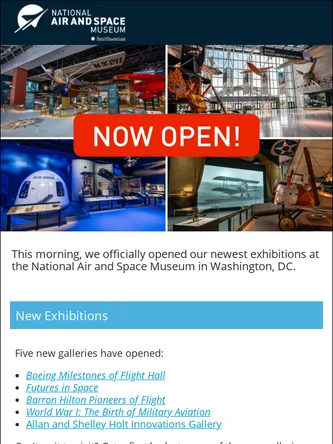
The museum's been undergoing this massive renovation-we're talking years-long, multi-phase transformation. Part of the Museum is closed while they complete renovations, with the entire building set to open July 2026. But even with construction happening, there's still plenty to see. They've already unveiled new galleries, a renovated planetarium, and updated exhibits that make the whole experience feel fresh.
And the artifacts? They're the real deal. The National Air and Space Museum holds in trust over 70,000 artifacts and more than 20,000 cubic feet of archival materials, including the 1903 Wright Flyer and the Apollo 11 Command Module Columbia. These aren't replicas or models-these are the actual machines that changed human history. You can see Charles Lindbergh's Spirit of St. Louis, Amelia Earhart's Lockheed Vega, and the Bell X-1 that Chuck Yeager flew when he broke the sound barrier.
There's also a planetarium and an IMAX theater (though check ahead because some features might be closed during renovations). The Mars Café on the lower level serves sandwiches, pizza, salads, and coffee if you need to refuel. And the three-level museum store is packed with everything from astronaut ice cream to model planes-perfect if you want a souvenir that's actually cool.
The museum isn't just about looking at old planes and spacesuits, though. It's about that moment when you realize humans went from barely getting off the ground to landing on the Moon in less than 70 years. It's about standing next to something that actually flew in space and feeling that weird mix of awe and disbelief. Whether you're bringing kids who are obsessed with rockets or you're just someone who appreciates human ingenuity, this place delivers.